

Specola di Padova
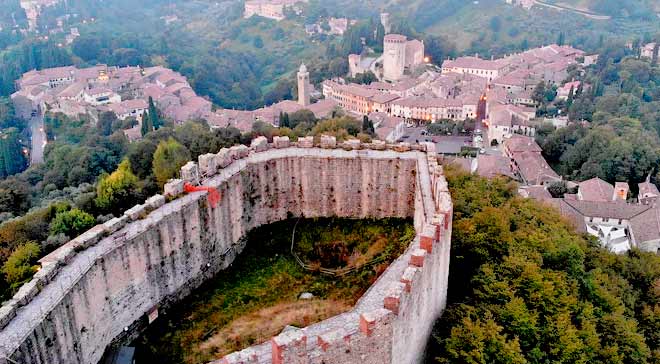
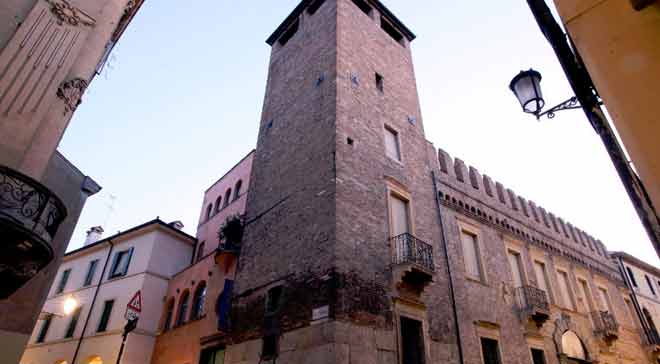
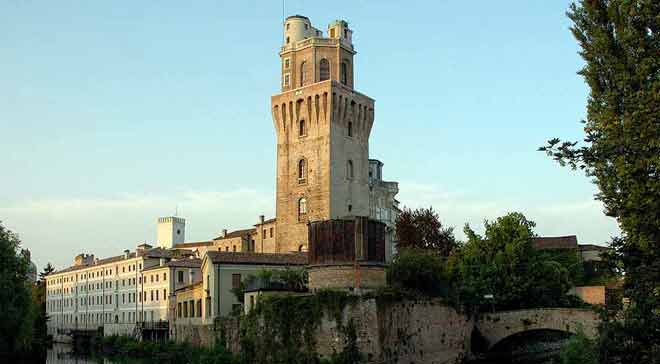
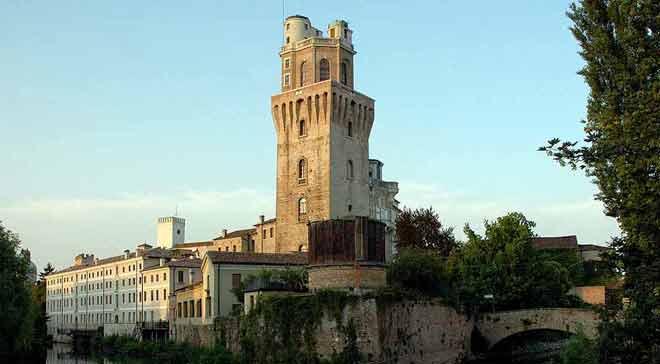
La Specola in Padua is the home of the ancient astronomical observatory of the University of Padua: it stands on the Torlonga, the taller of the two towers of the old Castle of Padua.
It is 49.59 m high, reaching 53.30 m with the lightning-rod aerial, over 252 steps (figures taken from the north cross-section of the Specola tower drawn by Giovanni Silva in 1911).
The Torlonga was an ancient defensive tower, built in the 9th century AD.
It was refurbished by Ezzelino III da Romano in the 13th century and is bound up with his reputation for cruelty: it served, in fact, as a prison and torture chamber for the tyrant's enemies. After the tyrant fell, the castle was abandoned.
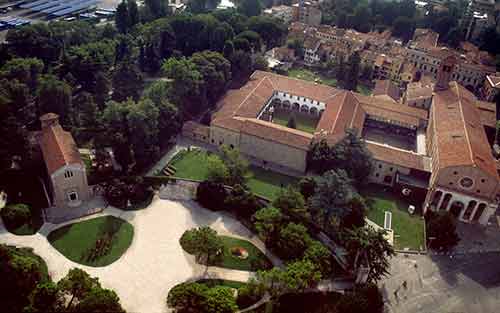
 In the second half of the 14th century the new lords of Padua, the Carraresi, built the new castle on the remains of the earlier one, running parallel to the Bacchiglione. In an old view of the city of Padua it is depicted painted in white and red checks (by Giusto de' Menabuoi in the Basilica di Sant'Antonio in Padua). With the construction of the 16th-century walls, the castle and the torlonga lost their military function and fell into disuse. Indeed, by the 18th century the old fortress, largely crumbling, was being called "Castel Vecchio", and had long since been turned into a store for grain, straw and hay, and a depot for arms and ammunition.
In 1761 the Venetian senate decreed the establishment of an astronomical observatory for the University of Padua. The project was championed by the abbot Giuseppe Toaldo who, together with the architect Domenico Cerato of Vicenza, made use of the existing tower, adding at its top the room giving access to the observation turrets.
The works, carried out to Domenico Cerato's design, involved the creation of two distinct observatories, each suited to performing a precise function. At the top of the tower the upper observatory would be built, an octagonal space fitted with tall windows so that, from inside the room, the sky could be observed from the horizon almost to the zenith. The surrounding terrace was to be wider towards the south so that some instruments could be placed there.
At a height of about 16 m the lower observatory would be built, a room designed specifically to read noon along the meridian line to be inscribed on the floor, and to observe the heavenly bodies as they crossed the celestial meridian. The record of the transformation of the prison-tower into a place devoted to astronomical study was inscribed on a plaque above the ground-floor door of the tower when the works were completed in 1777.
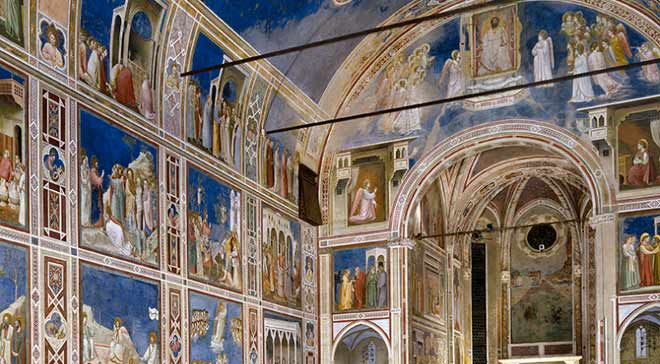
From September 1772 to August 1773 the octagonal room of the upper observatory was frescoed by the Vicenza painter Giacomo Ciesa with astronomical subjects devised by Toaldo. In the 18th century, and up to the early years of the 19th, the Specola was reached from what is now piazza Castello.
In 1773, even before the works on the Specola were finished, Toaldo obtained permission to install a lightning rod. The one on the Specola was the first lightning rod fitted to a public building in the Venetian Republic - the invention had been made by Benjamin Franklin in 1750 - with the advice of the Geneva professor Saussure, who was passing through Padua.
In 1777 La Specola in Padua was at last completed as a building, but the same could not be said of its set of instruments. The instruments were acquired in several stages; in 1779, after a voyage by sea from England to Venice, and then by boat from the lagoon city to the Observatory, a large quadrant arrived, which was fixed to the specially prepared wall and oriented with great precision along the north-south axis inside the meridian room. On the whole, by the end of the 18th century the Specola's set of instruments comprised quadrants, refracting telescopes, pendulum clocks, and other instruments for measuring the celestial coordinates, such as the transit instrument and the parallactic machine.
On 25 July 1806 Napoleon issued the decree by which the University of Padua was preserved, and with it the Observatory.
When Italy entered the war on 24 May 1915, Padua, after Udine, became the seat of the Supreme Command of the armed forces: the telegraph apparatus in use at the Observatory for the time service was requisitioned by the General Command; in 1916 the tower was requisitioned for the service of spotting enemy aircraft. In 1919 the Observatory's premises were handed back to the University of Padua.
With the building of the Asiago branch in 1942 (Asiago Astrophysical Observatory) and its development in the years that followed (Asiago Cima Ekar Observing Station), the Specola tower was no longer used to carry out astronomical observations. Some rooms were instead converted to house the historic library and the archive. In 1994 the Padua Observatory, legally autonomous since 1923, applied to the Ministry of Finance to acquire a new building, the so-called 'Casa del Munizioniere' of the Castelvecchio, which had become the prison infirmary under Austrian rule. In the same year the governing board resolved to establish the museum section of the Observatory, under the name "Museo La Specola". The acquisition of the new spaces, which took place a few years later, then allowed the Observatory to expand the museum route and to devote the tower entirely to a museum.
Since 1994, therefore, the Museo La Specola has preserved, restored and displayed the observing instruments used by Padua's astronomers over the 250 years of their history.