

Chiesa degli Eremitani
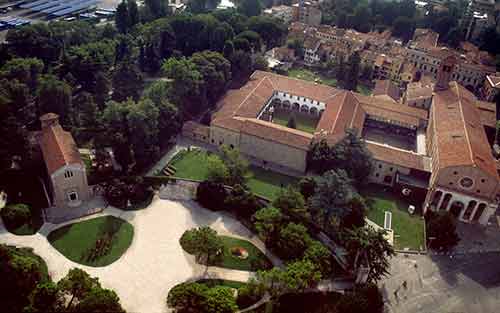
The church of Santi Filippo e Giacomo is a medieval Catholic place of worship that rises in Piazza Eremitani in Padua.
Dedicated to Saints Philip and James the Less, it was built from 1264 onwards as the church of the Order of the Hermits of Saint Augustine, who had their large convent to the north of the church, today occupied by the Civic Museums at the Eremitani.
The Augustinian order ran the church until 1806. Today the church holds parish status and is led by the secular clergy of the Diocese of Padua.
According to tradition, the construction was carried out under the guidance of Friar Giovanni degli Eremitani. The building, an extraordinary example of the “classicising” style that developed in the Padua of the communal age, preserves remarkable works of art, including the first paintings by Andrea Mantegna.
Resting within it are, among others, the remains of the knight Zanino da Peraga, Ilario Sanguinacci, Jacopo da Forlì, the humanist Marco Mantova Benavides, the noblewoman Vittoria Accoramboni, the physician and biologist Antonio Vallisneri, and the singer and composer Barbara Strozzi.
The church was hit hard by an Anglo-American air raid in 1944.
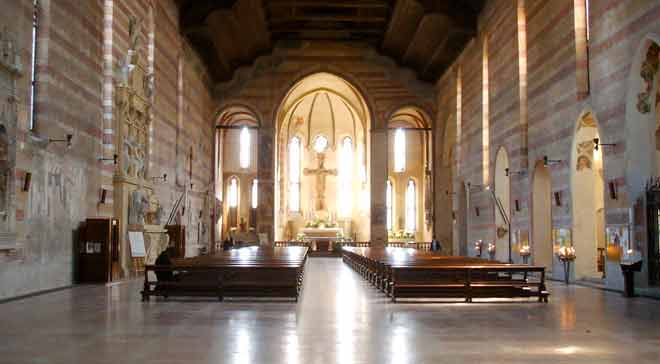
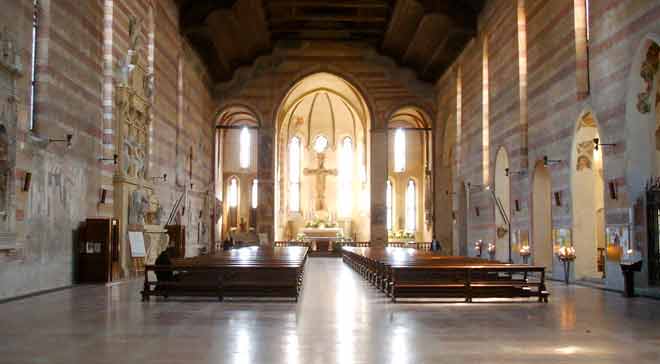
The single-nave church, of the so-called barn type, is rather elongated, ending in 3 apses — the side ones with a straight termination, the central one with a 5/10 (pentagonal) closure — and has a wooden roof.
The right side chapel adjoins the famous Ovetari chapel. On the right, southern side, four side chapels open up.
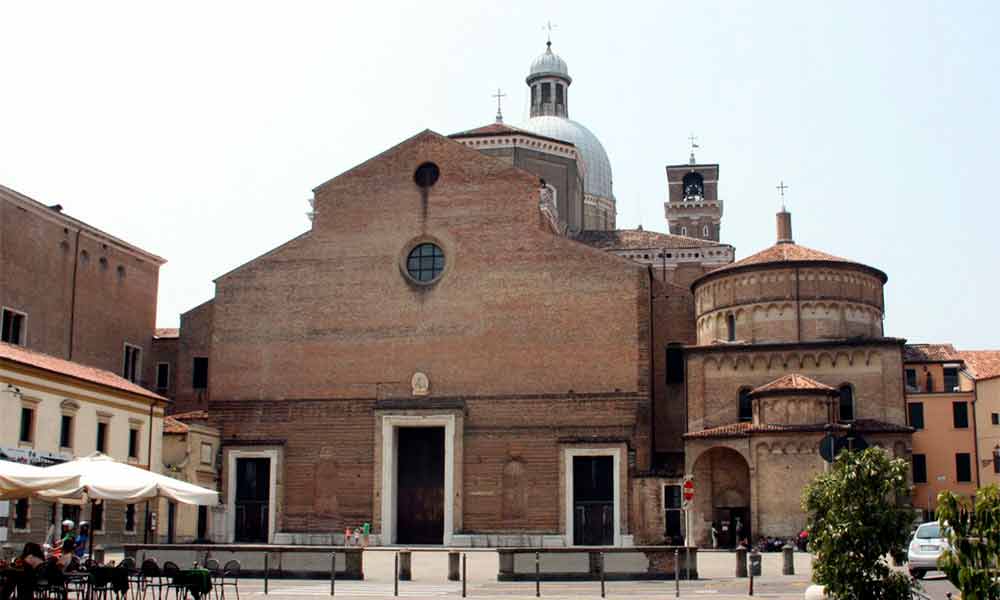
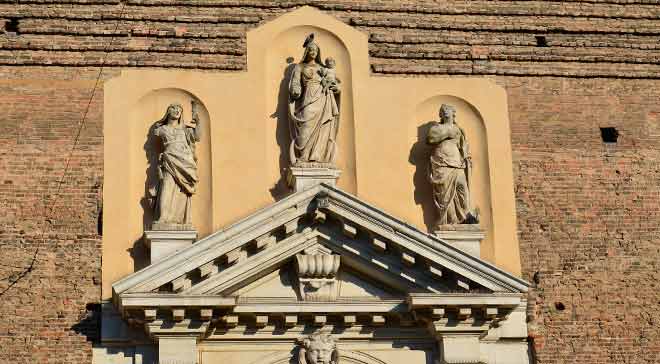
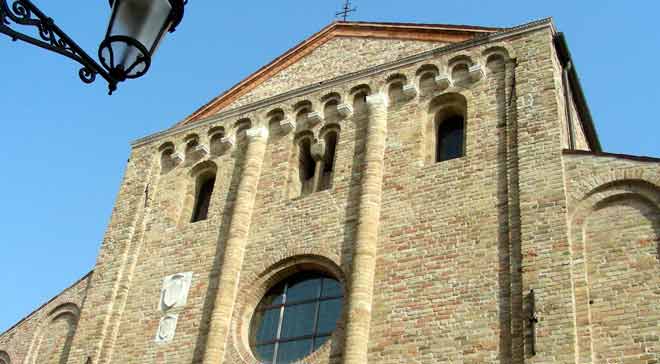
The gabled façade is opened at the top by a rose window, while the lower part features a stone pseudo-loggia with five arches; the central one holds the entrance portal, while the side ones hold tombs. The southern side portal, dating from the Renaissance, is decorated with twelve high reliefs depicting the months, the work of the Florentine Niccolò Baroncelli and dating back to 1422.
Over the centuries the church was enriched with decorations and works of art, which were partly lost during the Anglo-American bombing.
The cause of the wartime bombs is undoubtedly to be traced to the military use of the former convent, as well as to its proximity to the railway station: the upper part of the façade, the ceiling and the apse area were destroyed and rebuilt after the war following the original, mostly using material salvaged from the rubble, respecting the technique of anastylosis, in the works directed by Ferdinando Forlati.
The interior consists of a single nave, with a keel-shaped ceiling rebuilt after the Second World War following the original model.
To the right and left of the entrance are the two funerary monuments of Ubertino and Jacopo II (sometimes also called Giacomo) da Carrara, brought here from the destroyed church of Sant’Agostino at the beginning of the 19th century: they were made, respectively, around 1345 and in 1351, by the Venetian sculptor Andriolo de Santi, by two other Venetian artists and by the Lombard Bonino da Campione, to whom the two “Madonnas with Child” in the central niches of the sarcophagi have been attributed.
Feltrino Gonzaga (†1374), lord of Novellara and Bagnolo, was buried in the church.
In the chapel of the Cortellieri family, located on the right side of the nave, some remains can be seen of a pictorial cycle created by Giusto de’ Menabuoi around 1370, depicting the Glory of Saint Augustine with the Virtues and the Liberal Arts.
On the left side of the nave an ancient clock is preserved.
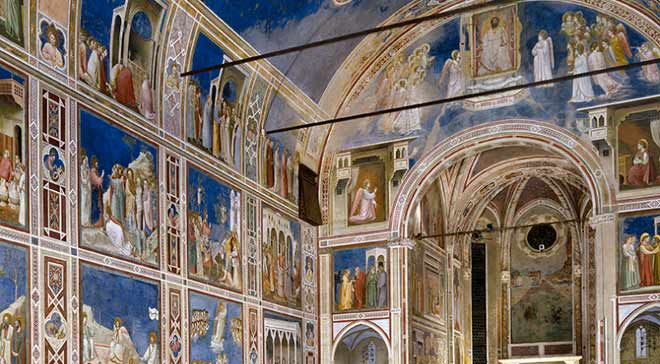
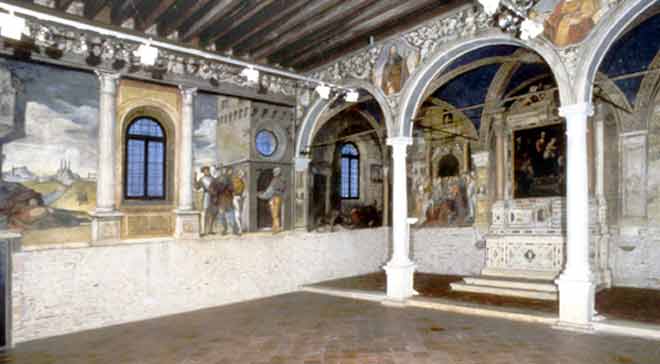
The main chapel is decorated with a cycle of frescoes by Guariento which, after the wartime destruction, now covers only the left (northern) wall, with the Stories of Saint Philip and Saint Augustine in the three upper registers and, in the monochrome dado, the allegories of the Planets and the Ages of Man: this part of the decoration is clearly influenced by the nearby frescoes by Giotto in the Scrovegni Chapel.
Guariento’s painting work in the main apse can be dated, on stylistic grounds, to the years 1361-1365.
The surviving scenes are:
- Saint Philip forced to sacrifice to Mars
- Meeting of Saint Philip with the bishops
- Martyrdom on the cross of Saint Philip
- Vision of Saint Augustine
- The vesting of Saint Augustine and the baptism of Adeodatus
The crucifix behind the main altar is the work of the Venetian Nicoletto Semitecolo (1367).
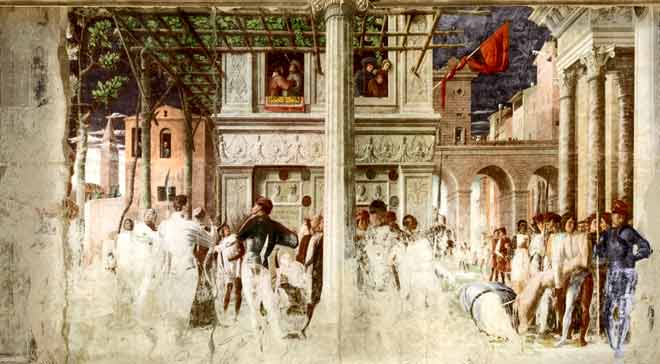
To the right of the main chapel are the frescoes of the Ovetari Chapel by Andrea Mantegna and other painters, such as Ansuino da Forlì.
They were reconstructed and put back on public display from 2006, starting precisely with the important fragment by Ansuino, after having been destroyed in the bombing of 1944.
Between the presbytery and the Ovetari chapel lies the small Dotto chapel; on the right wall is the funerary monument of Francesco Dotto.
The chapel, dedicated to Saints Cosmas and Damian and located to the left of the main altar, is better known by the name of Sanguinacci Chapel, after the family that held its patronage.
On the upper right wall is the fresco of the Madonna and Saints, the work of the Master of the Scrovegni Choir, dating to around the fourth decade of the 14th century.
Below can be seen the Madonna enthroned with Saints and a donor, who may be the German nobleman Enrico Spisser, at that time in the service of the Carraresi.
The fresco was made around 1373, probably by Giusto de’ Menabuoi.
On the left wall the remains of a votive fresco with heraldic emblems are visible, largely lost due to the placement of the funerary monument of Ilario Sanguinacci, military leader and podestà of Bologna and Florence, who died in 1381.
In the new sacristy, now the weekday chapel, some fine works of art are preserved, among which should be listed Christ and the Samaritan Woman, Christ and the Adulteress, the Wedding at Cana and a David by Pietro Ricchi; Saint John the Baptist recently reattributed to Guido Reni; Madonna with Saints by Ludovico Fiumicelli; Madonna with the Child Jesus by Altichiero da Zevio and the tombstone of Paolo Veneto, theologian.
Mausoleum of Marco Mantua Benavides
After his move from Mantua to Padua, the learned scholar and man of letters Marco Mantua Benavides had a grand mausoleum built in 1544, the work of the Florentine sculptor Bartolomeo Ammannati. On the sides of the sarcophagus are the two statues of Labour and Patience, while in the upper part is the statue portraying the patron between Time and Fame. The whole is dominated by Immortality.
The monument is made of yellow Nanto stone, while the statues are of white marble.
(Source: wikipedia)