

Piazza della Frutta
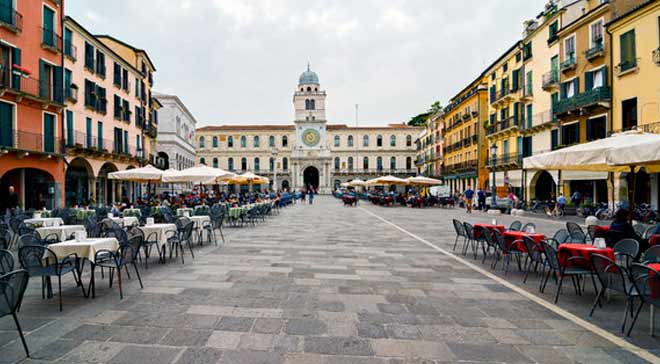
Piazza della Frutta, once also called Piazza del Peronio, is one of the many squares that characterise the historic centre of Padua.
For centuries it was, together with Piazza delle Erbe, the commercial centre of the city. In the two squares one of the largest markets in Italy takes place.
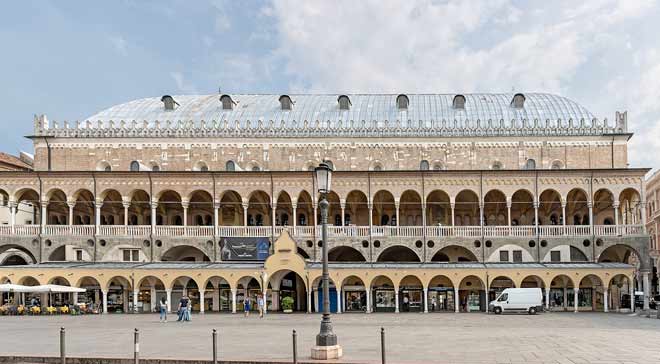
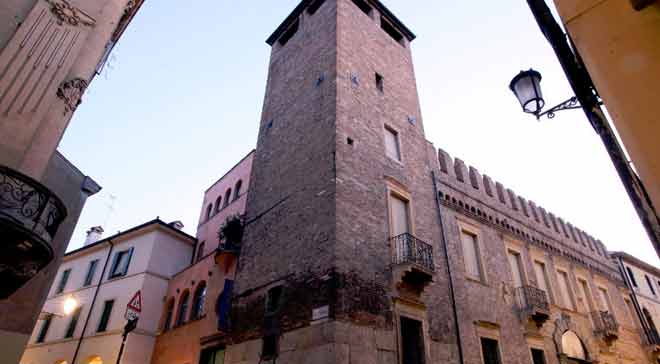
The square is dominated by the bulk of the Palazzo della Ragione, part of the great Palazzo Comunale, and by the Torre degli Anziani.
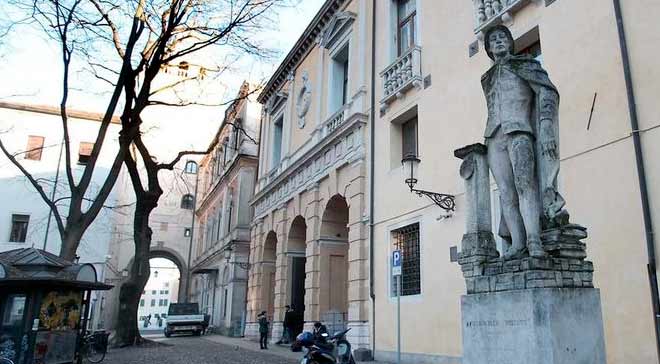
The square is distinguished by the Colonna del Peronio.
The square may also be called Piazza delle Frutta, according to an ancient usage that provides for the feminine plural in -a of the word 'il frutto'.
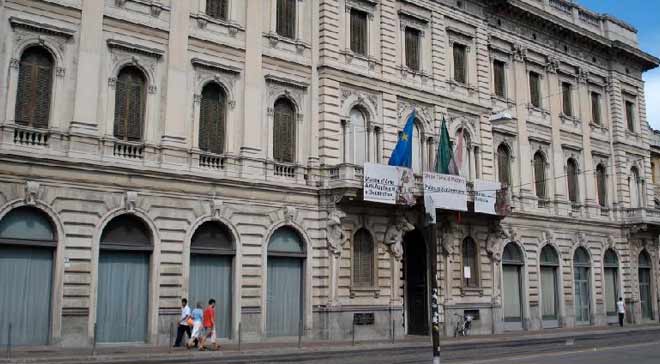
The area was lively in the pre-Roman age, as the numerous archaeological finds testify. According to some it was a centre of trade as early as the imperial age, but it owes its present form to the 10th and 11th centuries. The space was occupied by numerous shops and stalls selling every kind of goods, especially vegetables and poultry. It was with the construction of the Palazzo della Ragione in the early thirteenth century that an attempt was made to arrange the various points of sale: beneath the great hall the sellers of fabrics and furs set up, while at the foot of the palace's staircases overlooking the square the awnings of the sellers of poultry and game were set up (the Scala dei Osei, to the east) and those of fruit and vegetables (the Scala dee Erbe, to the west), while in the open space the movable stalls of the sellers of footwear and leather were installed. Beneath the Torre degli Anziani there were the salt sellers, while in the corner later called Canton dee Busie where the merchants carried out dishonest dealings, the Paduan units of measure were carved, which could serve to debunk deceitful transactions. Giovanni da Nono in his Visio Egidii testified with great precision to the enlargement of the Palazzo della Ragione in 1309 and to the arrangement of the shops at that time. In the seventeenth and eighteenth centuries the medieval houses to the north were rearranged, with the straightening of the porticoes. In the first half of the nineteenth century the balconies supported by wooden columns on the houses to the west and north were definitively removed, while at the beginning of the twentieth century the row of houses to the east was rearranged with the widening of the contrà del sale, later via Oberdan. The neoclassical building on the north-west corner is the work of Antonio Noale.
In the square, on the day of the "zoba masa", that is the first Thursday of May, the Guild of the "strazzaroli", junk dealers and traders in second-hand goods, put on a show with the greasy pole. The prize consisted of a purse and gloves, for which reason it was called the "Festa della Borsa" (Festival of the Purse). A marble purse is carved in memory of it, on the building in via Marsilio da Padova, at the corner with via Gorizia.
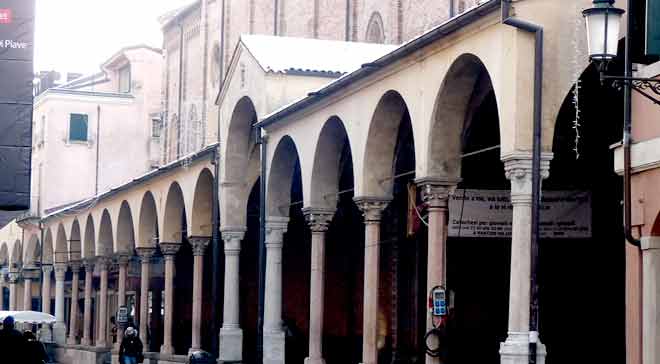
Overlooking the square are some of the oldest shops in Padua: beneath the loggia of the Palazzo del Consiglio stands the ancient apothecary's shop "Ai due catini d'oro", already in existence in the 18th century. Not far away, the pastry shop "Graziati", founded in 1919: it occupies part of a portico bay with rooms dating from the 12th century.
COLONNA DEL PERONIO
The Peronio is a medieval column placed in the centre of Piazza delle Frutta. It was perhaps used as a support for an awning for commercial purposes or as a marker for the arrangement of the stalls that were set up in the square in the morning. Its name perhaps derives from the Latin perones, the leather footwear that was sold nearby or, as in the case of Vicenza, from Perones meaning "set of areas of public property". It is surmounted by a capital at whose corners are depicted a pumpkin, a palm, a quince and a pear tree, and is then crowned by a small Istrian-stone obelisk with an ancient weathervane, on which is depicted, in bas-relief, the coat of arms of the city and San Prosdocimo. After having been placed in Prato della Valle for almost a century (in the corner of via Briosco), in the mid-1990s it was restored to its original position.