

Chiesa di San Francesco Grande
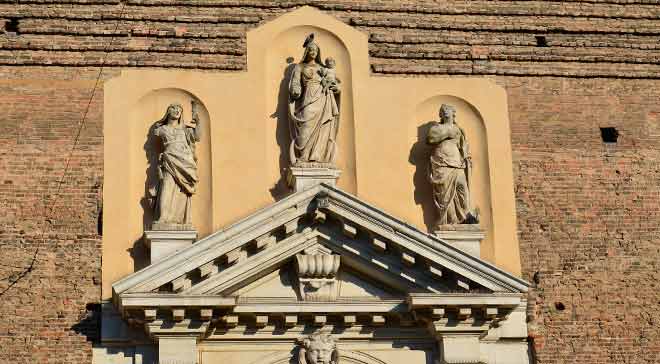
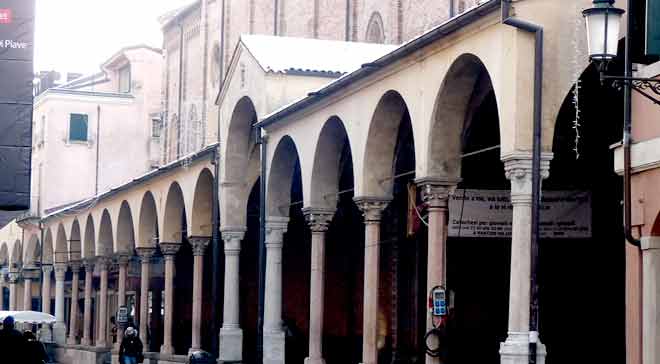
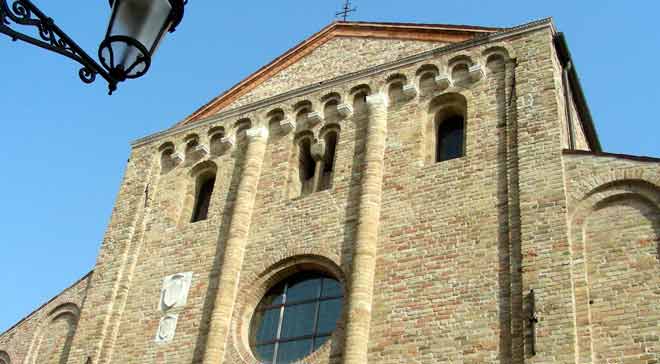
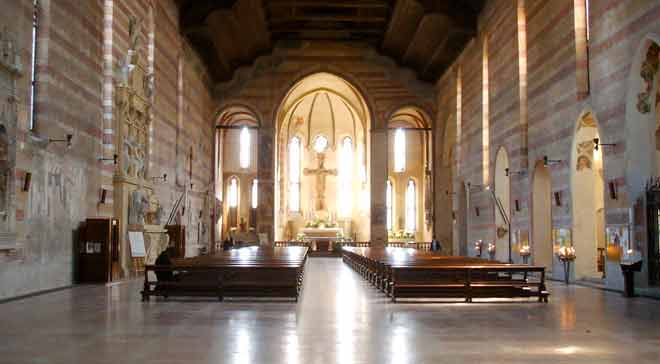
The church of San Francesco d'Assisi, formerly called the church of San Francesco Grande (so as not to confuse it with the church of San Francesco Piccolo, which had already disappeared by the 16th century), is a religious building overlooking via San Francesco, formerly contrà dei porteghi alti, in Padua.
Through the benefactory wish of Baldo de' Bonafarii and Sibilla de Cetto it arose together with the convent of the Friars Minor who still care for it, and with the Hospital of San Francesco Grande which was in use until 1798.
On 29 December 1414, in the episcopal palace of Padua, before Bishop Pietro Marcello and other witnesses, Baldo Bonafari and his wife Sibilla da Cetto declared their wish to devote part of their possessions to the construction of a church with a convent and a hospital in contrà Santa Margherita, to be assigned to the Observant Friars Minor. Bonafari reserved the right to elect the rector of the hospital, a right that upon his death would pass to the College of Jurists of the University of Padua. The first stone was laid on 25 October 1416 by the Archpriest of the Cathedral, Bartolomeo degli Astorelli. The construction of the church within the territory of the parish of San Lorenzo at first caused some uncertainty; the bishop consented and the works proceeded swiftly, led by the master builder Nicolò Gobbo. After the death of Bonafari the work was brought to completion by his wife Sibilla who, in her will of November 1421, asked to be buried in the new church, probably nearing completion. The building arose in the form of a Latin cross, in Gothic style, and was consecrated on 24 October 1430. In the mid-fifteenth century the chronicler Savonarola described it as templum quidem magnum, but by the end of the century it was already insufficient for the community of the Minors. At the beginning of the sixteenth century the church was enlarged under the direction of the architect Lorenzo da Bologna. The fifteenth-century church - in the form of a Latin cross with three apses and a nave divided from the choir, three communicating chapels on the left side - was greatly enlarged: a large presbytery was built which accommodated new ample choir stalls. The fifteenth-century nave was flanked by two spacious minor naves with chapels. The church was immediately the object of great works of a benefactory nature which enriched the building, above all between the sixteenth and seventeenth centuries. (...)
In 1728 the bishop of Padua counted 22 altars, which had decreased to 17 by the time of the visit of Bishop Dondi dell'Orologio in 1809. Owing to the Napoleonic suppressions the community of the Observant Friars left the building and the convent in April 1810 and in the same year it became a parish church cared for by the secular clergy. It absorbed into its own territory the parish of Santo Stefano, into which the parishes of San Lorenzo and San Giorgio had already been merged in 1808. In 1862 the floor was renewed, and on that occasion the many tombstones with which it was strewn were removed. Many were moved among the cloisters. In 1873 the church underwent a comprehensive restoration.
In 1914 the Friars Minor returned to the church and to part of the old convent, taking possession of the parish that they still care for.
In the church were buried, besides the founders Baldo and Sibilla, numerous illustrious figures such as the man of letters Bartolomeo Cavalcanti, the physician and philosopher Pietro Roccabonella, the archpriest of Barbarano Mossano Bartolomeo Sanvito, the jurisconsult and canon of the Paduan chapter Girolamo Negri, the physicians Ermenegildo Pera and Nicolò da Rio and also Girolamo Cagnolo and the Florentine Antonio Berardi, the canon Ginolfo Sperone degli Alvarotti.
Also buried in the church are Ferdinando Carlo di Gonzaga-Nevers, last duke of Mantua, and the painter Francesco Squarcione.
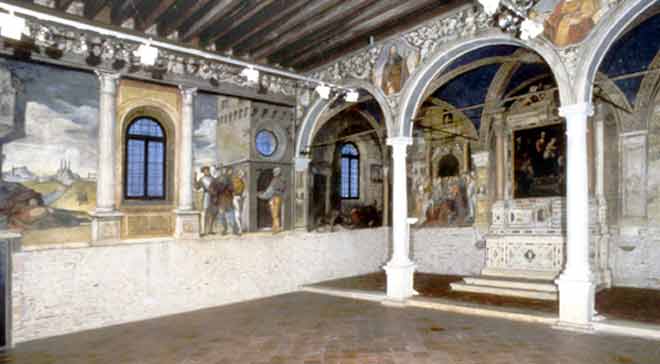
Subject to the parish with the title of oratory is the Chiesa di Santa Margherita, and parish property too is the Scuola della Carità.