

Basilica di Sant’Antonio di Padova
The Pontifical Basilica of Sant’Antonio di Padova is one of the principal Catholic places of worship in the city of Padua, in the Veneto.
Known to the people of Padua simply as il Santo, it is one of the largest churches in the world and is visited each year by over six million pilgrims, which makes it one of the most venerated shrines in the Christian world. It is not, however, the cathedral of Padua, a title that belongs to the duomo. It houses the relics of Saint Anthony of Padua.
The square in front of it is home to Donatello’s equestrian monument to the Gattamelata. Donatello also created the bronze sculptures (the Crucifix of the Basilica del Santo, statues and reliefs of various sizes) which Boito placed on the high altar he himself designed.
It holds the rank of papal basilica, one of the three belonging to the Holy See that are not located in Rome, and its administration is the responsibility of the Holy See itself, although it does not enjoy the right of extraterritoriality.
The current Pontifical Delegate is Mons. Francesco Gioia, archbishop emeritus of Camerino. The pastoral governance and administrative management of the Basilica of Sant’Antonio are regulated by the Apostolic Constitution of John Paul II entitled Memorias Sanctorum, which defines the duties and relations between the Pontifical Delegation, the Franciscan Friars, and the body known as the Veneranda Arca di Sant’Antonio, which has served uninterruptedly since 1396 as the fabric office of the Antonian complex. (…)
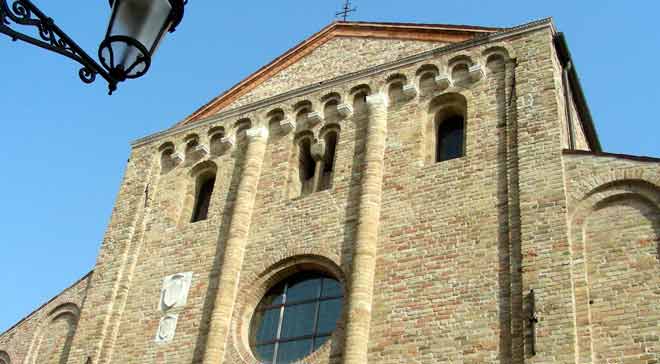
It is characterised by a perfect harmonisation of different styles: the Romanesque gabled façade; the buttresses that develop into flying buttresses in Gothic style which, in parallel, regularly mark out the space, and the domes in Byzantine style, mediated through Venice; and the two twin bell towers which, instead, almost recall minarets.
The Chapter cloister houses interesting tombs of professors of the University of Padua, among which those of Bonjacopo Sanvito and Raniero Arsendi.
The façade is about 28 m high and about 37 m wide; there are five recessed arches, the central one surmounted by a niche containing the statue of the Saint, and below it opens the main door. In the lunette of the main portal there is a copy by Nicola Lochoff of Andrea Mantegna’s fresco depicting Saint Anthony and Saint Bernardino adoring the monogram of Christ. The original fresco, detached, is preserved in the nearby convent. In the niche one can see the stone Statue of Saint Anthony, a copy made in 1940 by Napoleone Martinuzzi to replace the original fourteenth-century one by Rinaldino di Francia, which was greatly disfigured by the years and the weather and is now preserved in the Antonian Museum.
On the façade open three bronze doors, made following the design plan of Camillo Boito (1895). On the central one can be seen Saint Louis of Toulouse, Saint Francis, Saint Anthony and Saint Bonaventure, the work of Giuseppe Michieli.
The churchyard of the basilica was used for centuries as a cemetery and some tombs are still preserved, such as that of the jurist Antonio Orsato, who died in 1497; the monument consists of an elegant aedicule with a funerary urn set against the left side wall of the basilica.
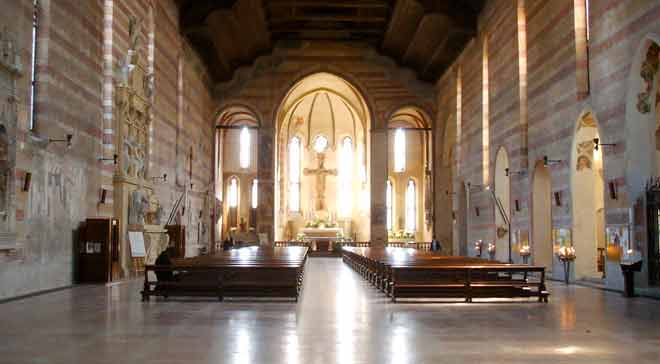
The interior is in the form of a Latin cross, divided into three naves by pillars; along the upper part of the walls run galleries. (Source: wikipedia)