

Basilica del Carmine
The Basilica del Carmine stands in piazza Francesco Petrarca in Padua.
In October 1960 Pope John XXIII raised it to the dignity of a minor basilica.
"Minor basilica" is the honorary title that the Pope grants to particularly important Catholic religious buildings.
The Basilica del Carmine was built in the 16th century to a design by Lorenzo da Bologna, starting from an older 14th-century church: its construction began in 1335, but the consecration dates to 1446.
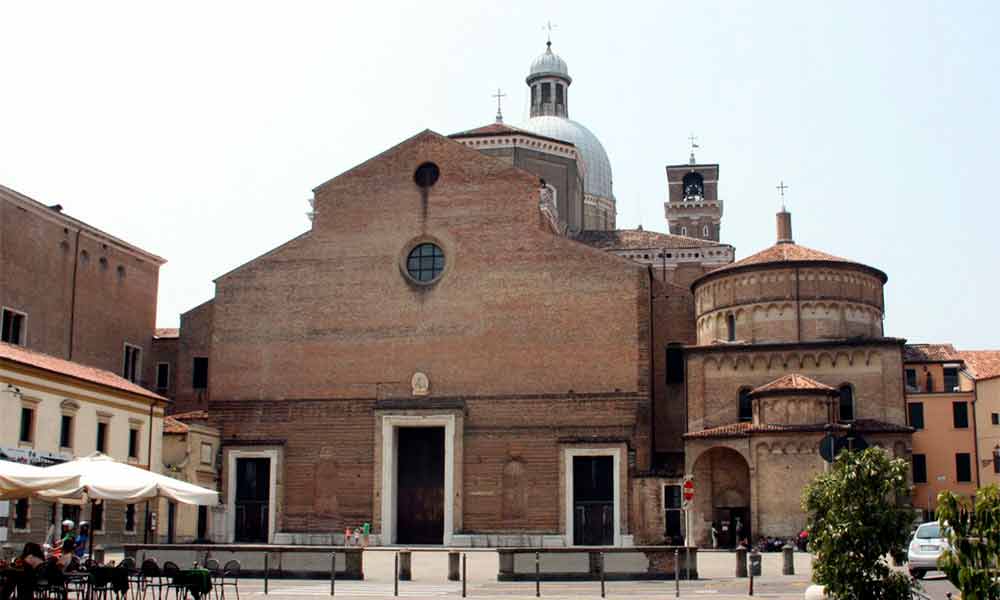
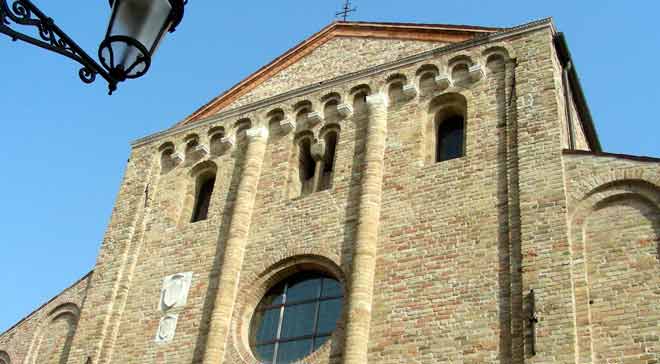
The building has been reworked several times over the centuries and the present façade was completed in the 18th century.
The original façade featured a loggia, as is also borne out by some 17th-century paintings found inside the Basilica, along the nave.
These paintings show the miracles worked by the Madonna del Carmelo for the people of Padua.
The main door, which was made in 1412, has wooden leaves decorated with square panels carved with acanthus-leaf motifs.
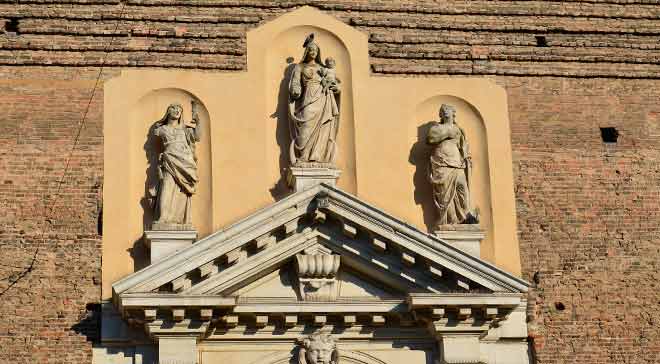
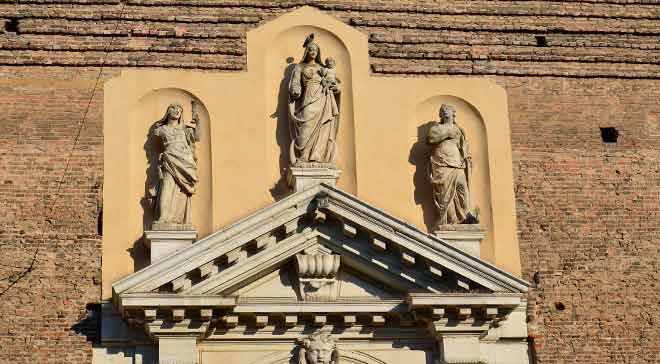
The portal, on the other hand, was completed in 1737 and is dominated by three statues, the work of Tommaso Bonazza (1736).
Beside the basilica, on the left, there are commemorative plaques to the parishioners who fell in the First and Second World Wars.
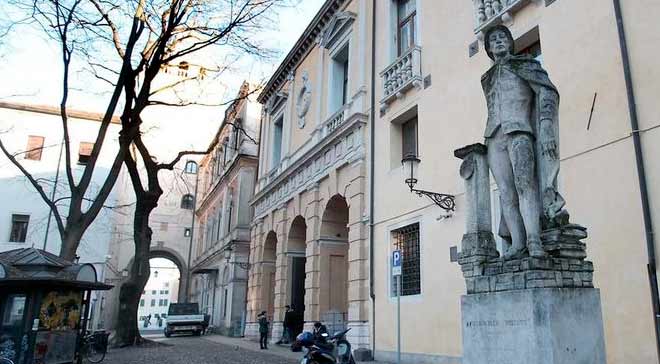
In the square in front of the basilica stands a statue of Francesco Petrarca.
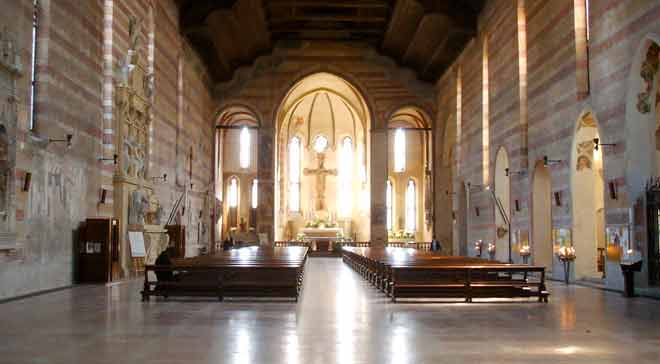
The interior has a single nave with mighty arches supporting the dome, rebuilt in the early post-war years after the destruction of the First World War.
On the counter-façade one can admire the Annunciation by Dario Varotari.
The two holy water stoups near the entrance are by Giovanni Bonazza.
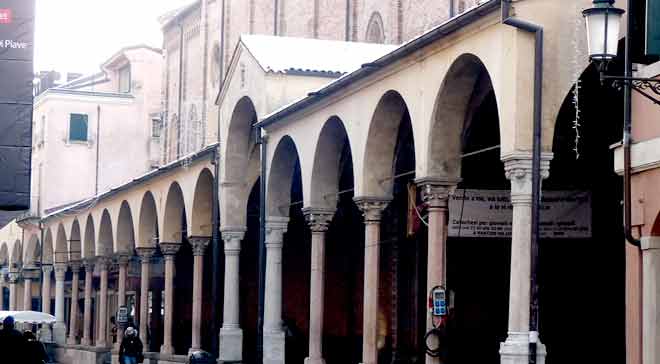
On the high altar, reached by a flight of steps, there is an image of the Virgin and Child, a detached fresco by Stefano Dall'Arzere: during the plague that broke out in Padua in 1576, the faithful carried this image in procession from the place in the city where it stood (behind the Palazzo del Capitanio, on the lunette of an arcade) to the Basilica; at once the plague ceased.
This occasion is still commemorated today with the Festa dei Lumini on 2 February.
On the antependium there is an 18th-century bas-relief depicting the Last Supper, while on the parapet of the organ to the left are Stories of the image of the Madonna del Carmine by Battista Bissoni.
The apse is adorned with sumptuous decorations by Antonio Noale.
The upper walls are covered with large canvases depicting Saints and events of the Carmelite Order and with Stories from the Old Testament, works by artists of the mid-17th century.

Inside one of the Chapels to the right of the central nave there is the statue of the Madonna del Carmine which is traditionally carried in procession through the streets of the neighbourhood every year, on 16 July. Inside the side niches hang some ex-votos for graces received.
Other works of interest inside the basilica are:
- Statues made by Giovanni Bonazza, on the third altar on the right;
- the altarpiece of the sixth altar on the right, depicting the Mother of the Zebedees before Christ, a work by Padovanino;
- the funerary Monument to Tiberio Deciani, a distinguished jurist, sculptures by Francesco Segala, set against the right pillar supporting the dome;
- the sacristy designed by Lorenzo da Bologna.
- The floor of the basilica is of polychrome marble. The De Lazara Polyptych by Francesco Squarcione, now in the Museo Civico of Padua, comes from the church.
Adjacent to the basilica, beside the Scoletta del Carmine, stands a 16th-century cloister.
In the bay covered by the dome there are two twin wooden choir lofts, both built in the 18th century, above which stand two Baroque organ cases; while the one on the left is empty (the organ formerly placed there, built by Gaetano Callido, was moved to the church of San Michele Arcangelo in Ballò in 1933), the one on the right houses an organ built in 1877 by Giovanni Battista De Lorenzi.
Some of the events that have damaged the structure of the church over the centuries:
- In 1491 the roof of the Basilica collapsed due to a snowfall and an earthquake
- In 1696 another earthquake again damaged the roof of the nave
- In 1800, during a fireworks display to celebrate the new Pope, the dome burned down completely
- In 1917 an Austrian aircraft set fire to the dome
- In 1944 the dome was damaged by a bombing, as can be read on a plaque commemorating the event, set on the façade.
- The church suffered serious damage during the World Wars, probably because it stood not far from the railway station and the old aqueduct.
Source: wikipedia