

Montagnana
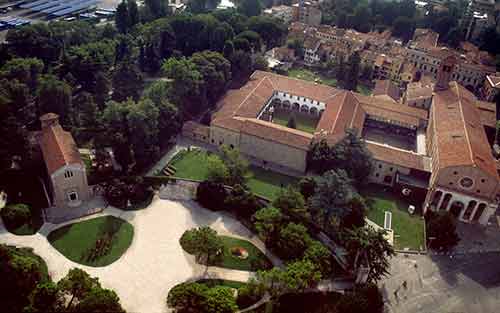
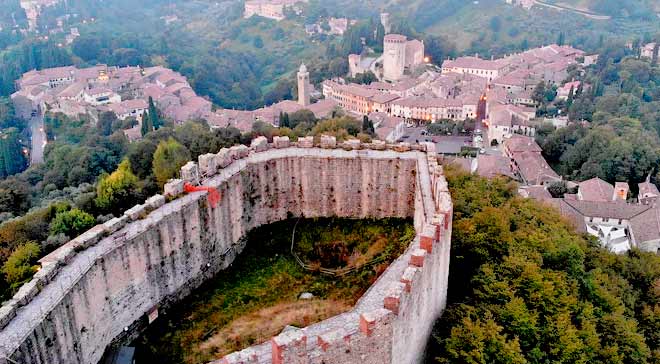
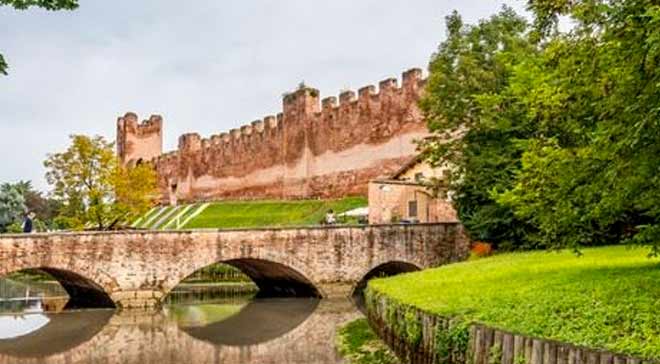
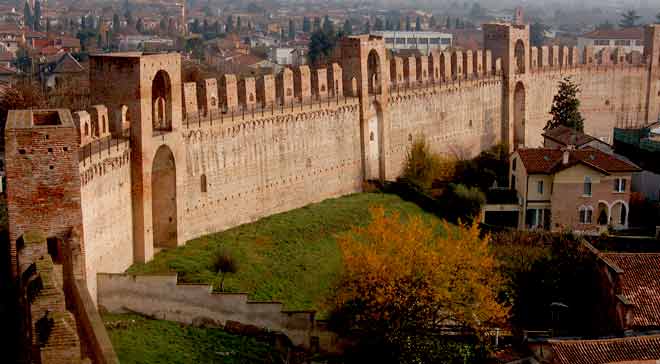
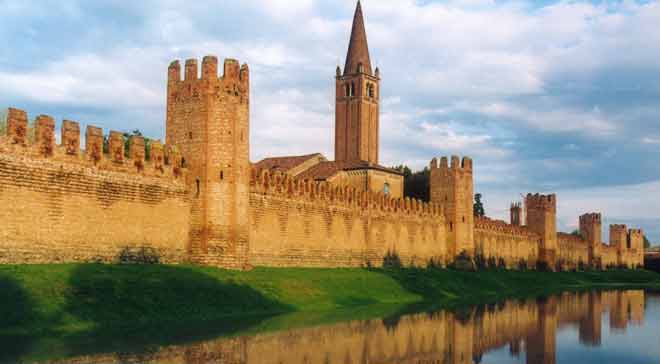
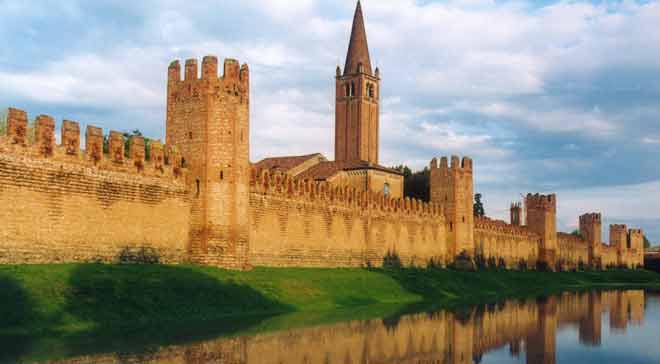
Among the walled towns of the Veneto, Montagnana is the one that has best preserved its medieval ring of walls.
The alterations are in fact few and barely noticeable, to the point that we can say that today we admire it more or less as it appeared in the 14th century.
Montagnana, a fortress town which, with a perimeter of almost 2 km, encloses a historic centre of considerable artistic and cultural importance, lies a short distance from important cities of art such as Padua, Verona, Vicenza, Mantua and Ferrara.
 Its favourable geographical position proved strategic as early as the late Neolithic, when the first settlements were formed. Already in Roman times it was an ideal point for controlling the region, also thanks to the river Adige, which flowed through it until the so-called "Rotta della Cucca", which occurred in the distant year 589 AD.
Like many other towns in the area, in the 10th century Montagnana was provided with fortifications, probably located where the Castello di San Zeno now stands, to defend itself against the frequent and devastating raids of the Magyars. Later the small village became the feudal centre of the well-known family of the Marquises, later called the Estensi, and played a leading role as a military stronghold within the wider context of the struggle between the Papacy and the Empire. In 1242 Ezzelino III da Romano (imperial vicar of Frederick II) set fire to the town with the intention of seizing it and resumed its reconstruction starting from the imposing Keep. The Guelph League soon managed to defeat the tyrant and the town returned into the hands of the Estensi, becoming part of the dominions of the Comune di Padova in 1275. As a reminder of the communal era, the walls built in brick adjacent to the two fortified gates of Castel San Zeno and Rocca degli Alberi remain.
In the 14th century the town passed under the control of the Da Carrara, Lords of Padua, who provided it with two new, extremely solid curtain walls in brick and trachyte, reinforced by no fewer than 24 watchtowers and by the imposing fortified gate of Rocca degli Alberi.
In 1405, after long years of exhausting wars against Venice, the town surrendered to the Serenissima, losing military importance but increasing its economic power, and enriching itself with artistic treasures thanks to the Venetian nobles who settled there.
Source >>>
(Introduction taken from Montagnana Itinerario turistico, by A. Costantini, 2002 edition, Ass.ne Pro Loco Montagnana.)