

Padua
According to an ancient legend, the city was founded in 1184 BC by the Trojan hero Antenor; in reality it originated from a Palaeo-Venetic settlement, probably in the 8th-7th century BC, and was mentioned by Livy as a river city already in existence in 302 BC.
A commercial centre, an ally of the Romans against the Cisalpine Gauls (226 BC) and a municipium in 49 BC, Patavium (this was its Roman name) became a rich agricultural and manufacturing centre (textiles), but declined in the period of the barbarian invasions and in 602 was destroyed by the Lombard Agilulf.
After the recovery, first under the Franks and then under the Ottonian emperors, with an episcopal government, from 1138 it gave itself communal institutions, took part in the wars against Barbarossa and grew wealthy through the working of wool and silk.
In 1222 the famous University was founded here and in 1231 the Franciscan preacher universally known as Saint Anthony of Padua died here.
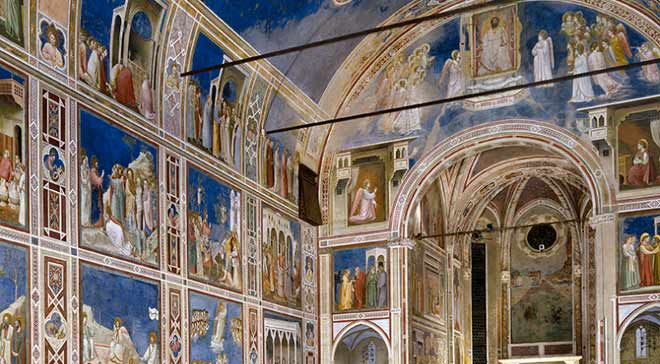
After having been part of the possessions of Ezzelino da Romano, Padua regained its hegemonic role over the territory and, at the beginning of the fourteenth century, hosted Giotto.
It was ruled by the lordship of the Carraresi and the Visconti between 1318 and 1405, when it was conquered by Venice, whose fortunes it followed thereafter, while maintaining throughout the century the pre-eminence it had acquired in the field of art, with the work of masters of the Tuscan Renaissance, including Donatello, and of the Paduan Mantegna.