

Caffè Pedrocchi
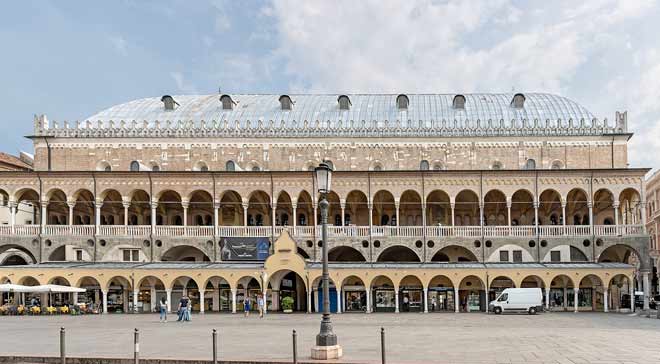
The Caffè Pedrocchi is located in the centre of Padua, in via VIII Febbraio; it is a historic café of international renown.
Open day and night until 1916 and therefore also known as the "Café without doors", for over a century it was a prestigious meeting place frequented by intellectuals, students, academics and politicians.
On 8 February 1848, the wounding of a university student inside the premises sparked the Italian Risorgimento uprisings; even today the episode is recalled in the official university anthem, Di canti di gioia.
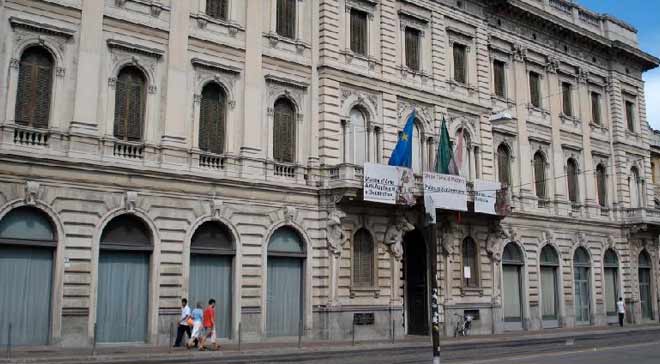
The Caffè Pedrocchi takes the form of a building with a roughly triangular plan, compared to a harpsichord. The main façade presents a tall base in smooth rustication, faces east and runs along via VIII Febbraio; onto it open the three main rooms of the ground floor: the White Room, the Red Room and the Green Room, so called from the colour of the wall hangings made after the Unification of Italy in 1861.
The Red Room is the central one, divided into three spaces; it is the largest and at present has its grooved marble counter restored, just as it was designed by Jappelli. The Green Room, characterised by a large mirror placed above the fireplace, was traditionally intended for those who wished to sit and read the newspapers without any obligation to order. It was therefore the favourite haunt of penniless students, and in Padua the saying essere al verde (to be broke) is traced back to this custom. The White Room, which faces towards the Bo, preserves on one wall the hole of a bullet fired in 1848 by the Austro-Hungarian soldiers against the students in revolt against Habsburg rule. Moreover, it is also known as the setting chosen by Stendhal for his novel "The Charterhouse of Parma". Completing the ground floor is the Octagonal Room, or Room of the Exchange, with not overly refined furnishings, originally intended for commercial dealings.
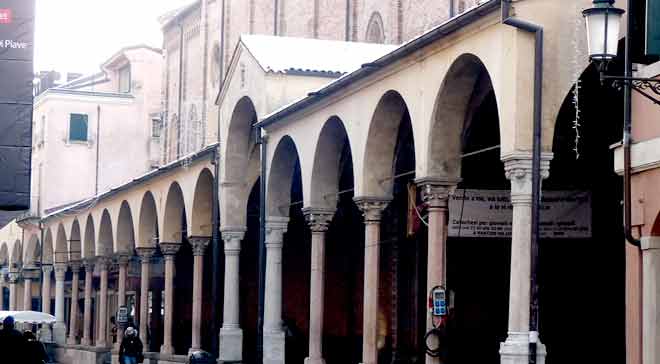
To the south the café ends with a loggia supported by Doric columns and flanked by the neo-Gothic body of the so-called "Pedrocchino". The latter consists of a turret on an octagonal base that serves as a source of light, thanks to the windows set on each side. Furthermore, inside it there is a spiral staircase. Two loggias in the same style are located on the north side, and in front of these stand four stone lions carved by Petrelli, imitating the basalt ones that adorn the ramped staircase of the Campidoglio in Rome.
Between the two loggias on the north side is a terrace bordered by Corinthian columns.
The upper floor, or "piano nobile", is arranged into ten rooms, each decorated in a different style:
- Etruscan
- Greek
- Roman: characterised by a circular plan;
- Baroque cabinet
- Renaissance
- Gothic-medieval
- Herculanean or Pompeian: typical are the decorations recalling the Roman villas;
- Rossini: it is the largest room, indeed it reproduces the same layout as the Red Room on the ground floor. In this room, dedicated to Rossini and Napoleon, we can observe stuccoes with a musical theme that symbolically represent its intended use.
- Moorish: very small;
- Egyptian: at the four corners of the room we find pedestals supporting a false entablature, and various attributes that recall Egyptian culture.
The key to interpreting this decorative apparatus may be the Romantic one of a nostalgic revisiting of the styles of the past. An esoteric or Masonic reading is not ruled out, however (Jappelli was a Freemason). The Egyptian symbols predate the deciphering of the hieroglyphic script by Champollion and are rather a tribute to the great Paduan explorer Giovanni Battista Belzoni, who had discovered numerous Egyptian monuments and of whom Jappelli had first-hand knowledge.
On the piano nobile of the Establishment is the Museum of the Risorgimento and of the Contemporary Age, where, among others, the portraits of the founder Antonio Pedrocchi and of his successor Domenico Cappellato Pedrocchi are kept, both works by Achille Astolfi.