

Piazza dei Signori
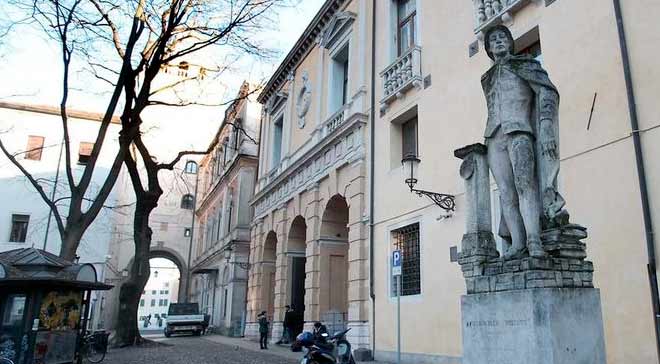
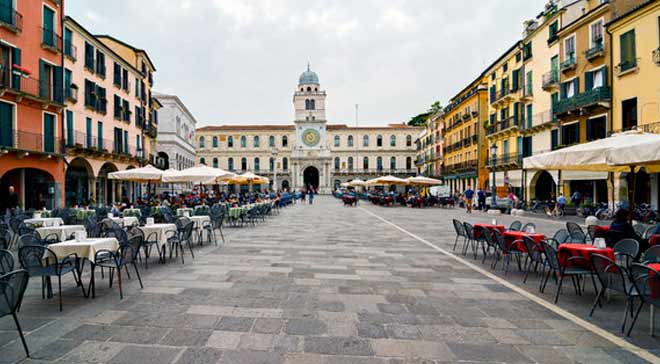
Piazza dei Signori or Piazza della Signoria is one of the many squares that characterise the historic centre of the city of Padua.
For centuries it was the setting for civic celebrations and tournaments and a space of representation for the city compared to the larger Piazza delle Erbe and Piazza della Frutta, which had greater commercial leanings.
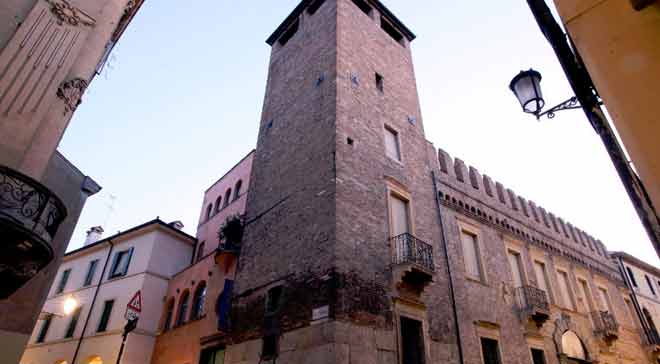
The square is dominated by the famous Torre dell'Orologio.
The square came into being in the 14th century with the demolition of an ancient quarter that extended in front of the churchyard of the church of San Clemente, the result of those urban rearrangements promoted by Ubertino Da Carrara. The opening of the square was conceived to give prominence to the eastern entrance tower of the Royal Palace that was then being built. Owing to its particular conformation, it naturally became the setting for tournaments and "castles of love". According to tradition, it was precisely from the "lords" Carraresi that the square took its name. The war between the Carrarese princes and the Visconti at the end of the 14th century damaged the square and its buildings so much that for a time it was called "della Desolazione" (of Desolation); in the 1420s the Venetians began a recovery of the space, which became the principal backdrop of the civic liturgy: for tournaments, jousts, battles, processions, concerts and musical festivities it became "Piazza dei Trionfi" and once again "Piazza della Signoria". On the occasions of the feasts of the patron saints and during official visits it was set up with ephemeral architecture. On the Thursday before Lent a great bull hunt was held. The 17th of July was the venue for the great celebrations to commemorate the reconquest of Padua by the Dominant power, in 1509. Following a speech by Father Alessandro Gavazzi, on the 9th of May 1848 it became "Piazza Pio IX", the heart of the anti-Austrian popular movements. It then became "Piazza Unità d'Italia", to return to its original name during the Fascist era.
In ancient times the square was paved with terracotta laid in a herringbone pattern, then gradually replaced from the 18th century onwards by slabs of Euganean trachyte.
In the square, at the entrance of stra' del pozzetto (today's via Nazario Sauro), until 1785 there stood a monumental well, adorned with marble columns and cannonballs. It was levelled in 1785 and closed with a seal - still visible - for reasons of decorum. The well-curb was then used to embellish the well of Piazza delle Erbe, the rest was all sold for a profit of 50 ducats.
Today the square hosts part of the city market in the morning, but it was once reserved solely for strolling and discussion.