

Prato della Valle
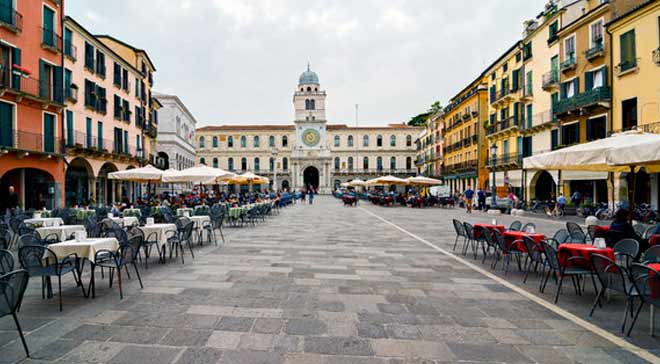
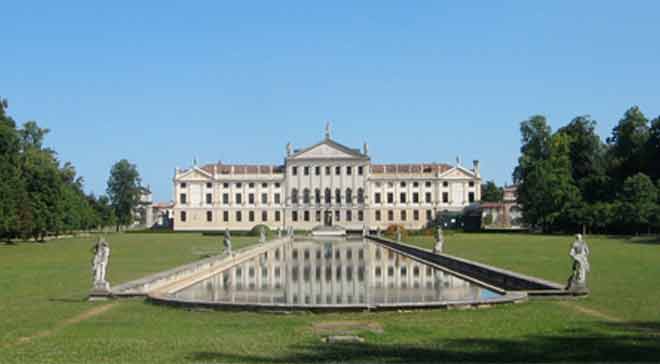
Prato della Valle is the largest square in the city of Padua and one of the largest in Italy and Europe, covering an area of 88,620 m².
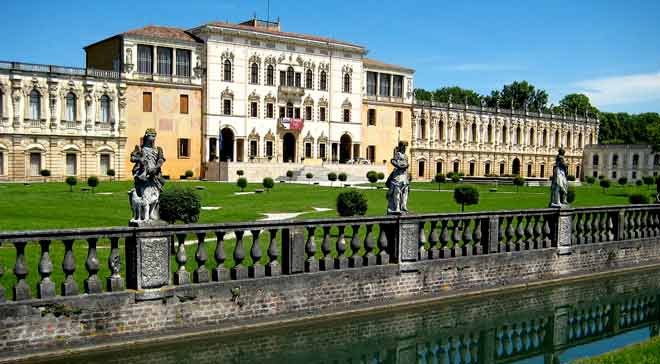
Its present-day layout dates back to the late 18th century and is characterised by a central elliptical island, called Isola Memmia (around 20,000 m²), surrounded by a small canal whose banks are lined with a double ring of statues, with an outer circumference of 1,450 metres.
In Roman and early medieval times the area was known as Campo di Marte or Campo Marzio, as it was used, among other purposes, as a venue for military gatherings. Later the area was referred to both as “Valle del Mercato”, after the seasonal markets and fairs held here, and as “Prato di Santa Giustina”, in reference to the church of the same name. The place name “Prato della Valle” (Pratum Vallis) is first recorded in the 12th century.
In medieval times, the term Pratum was used to indicate a large open space set aside for commercial use, which often, if unpaved, could become covered with grass. It should therefore be understood above all as indicative of the area’s prevailing function rather than of any actual grassy covering.
The term Valle means “low-lying ground” and “marshy place”. It derives from the slightly concave shape of the area, which was prone to flooding and subsequent waterlogging of the soil until the late 18th century.
Under the House of Savoy the area was officially named Piazza Vittorio Emanuele II, although in common usage it continued to be called by its historic name of Prato della Valle. (…)
The Prato della Valle area has been the subject of a complex regeneration project since the early 1990s.
This regeneration concerned both the physical aspect of the area and its social and functional dimension. Progressive restrictions on cars have almost entirely removed the parking areas once used outside Isola Memmia. A new arrangement of the island’s vegetation has allowed the area to be enjoyed by large numbers of young people, especially in the summer months, as a gathering place to study outdoors or sunbathe. Increased street lighting has also made evening use possible, particularly in summer, when the island is crowded with young people, among whom genuine groups often form to entertain the public with music or small improvised performances. For some years now the outer ring of the island, being asphalted, has often been used by skaters; on some occasions genuine professional skating competitions take place there.
The Prato naturally also retains its historic functions as a place of trade and entertainment. Every Saturday it hosts Padua’s traditional market with over 160 stalls, and every third Sunday of the month the antiques market. Since autumn 2007, some stalls of the daily fruit and vegetable market in the squares around the Palazzo della Ragione have been moved to the Prato.
Several times a year the Prato hosts concerts (the Festivalbar stopped here on a number of occasions) with tens of thousands of spectators. The legendary band Pooh also performed here in 2006 for their fortieth anniversary, drawing well over 120,000 spectators. Every New Year’s Eve and on the Ferragosto holiday, celebrations with music and fireworks are organised in the Prato; the Ferragosto displays are particularly popular and draw spectators from all over the Veneto. During major sporting events, such as the football World Cup, giant screens are set up to follow the action. The square is also the traditional venue for celebrations whenever Italian football teams win.
The southern side of the square, behind the building of the former cattle market (foro boario), will shortly be affected by a transformation and redevelopment project (the so-called Crotti Project). It involves restoring the façade of the former cattle market and building an underground car park behind the building itself, in the area currently used as a surface car park. The grandstands of the Appiani Stadium on the eastern side will be demolished and replaced by a smaller wooden structure, while retaining the sporting function of the pitch. Roofing of the Monti velodrome is also planned.

There are currently 78 statues (40 along the outer ring and 38 along the inner one), but according to the original design there should have been 88. The present arrangement results mainly from the destruction of six statues depicting Venetian doges, torn down by Napoleon’s army in 1797; following this episode several statues were repositioned and, above all, the current obelisks, previously placed along the island’s four inner avenues, were set on the pedestals of the eastern and western bridges (which had originally also been intended for statues). The two inner pedestals of the northern bridge are still without statues.
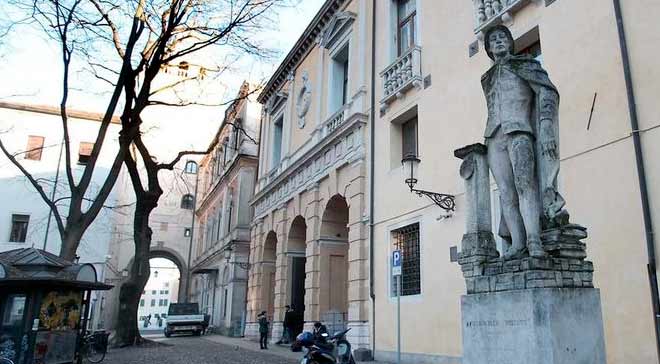
A precise set of rules (issued by the Presidency of the Prato on 10 February 1776) laid down the criteria for creating the statues: living people could not be portrayed, saints could not be portrayed (church altars were reserved for them), and all the figures depicted had to have had a connection with the city. In most cases they are in fact university professors, artists, military commanders or former rulers of the city. The first statue to be made, in 1775 as a trial, was a statue of Cicero, which was quickly removed because of the lack of any connection between the figure and Padua; it was replaced by the current statue of Antenor, donated to the city by Andrea Memmo himself. The last of the original statues was that of Francesco Luigi Fanzago, placed in 1838. Later, during the 19th century, the statue of Antonio Savonarola was remade because it had deteriorated too badly and finally, in 1963, for conservation reasons, the only statue carved by Antonio Canova, representing Giovanni Poleni, was replaced by a copy (the work of Luigi Strazzabosco). All the statues depict male figures; the only exception is the bust of the poet Gaspara Stampa, placed at the foot of the statue dedicated to Andrea Briosco. The pedestals and statues are made of Vicenza stone, a soft limestone quarried in various places in the Berici Hills. It lends itself very well to sculpture thanks to how easily it can be carved, but on the other hand it deteriorates readily. Various restoration and conservation works have been carried out on the statues since the late 19th century[15]. The last extensive intervention on the statues dates back to the early 1990s[16].
The statues were fundamental to the transformation of the Prato, not only visually but also financially. They were in fact paid for by individual citizens or groups upon payment of a sum that could vary between 135 and 150 zecchini, which served both to cover the direct cost of the statue and as a contribution to the general works on the Prato. The sum could also be paid over two or three years. (Source: wikipedia)