

Monselice
The conferral of city status on Monselice dates back to 7 June 1960; it lies in the province of Padua.
The districts of Monselice are: Centro, Montericco, Carmine, San Martino, Costa Calcinara (or Redentore), Marco Polo, San Giacomo (or Frati); while the hamlets of Monselice are: Ca' Oddo, Marendole, Monticelli, San Bortolo and San Cosma.
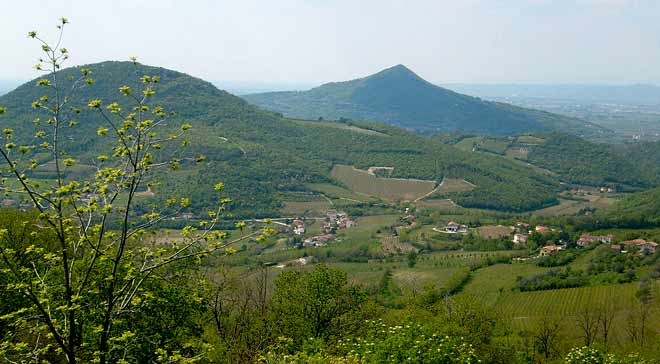
The meaning of "Monselice" derives from mons silicis, in connection with the extraction of stone from the hill around which the town spreads, or from mons elicis (mount of the holm oaks), from a species present on that same hill, or again mount of flint because of the flint quarries on the surrounding hills.
The first settlements in the area are very ancient. The two legends that would have Monselice founded by Ossicella, a companion of Antenor, or by Egina, queen of the Rocca, somehow lend credit to such a claim. Numerous archaeological finds also attest to the presence of at least a prehistoric station that developed between the Iron Age and the Bronze Age.
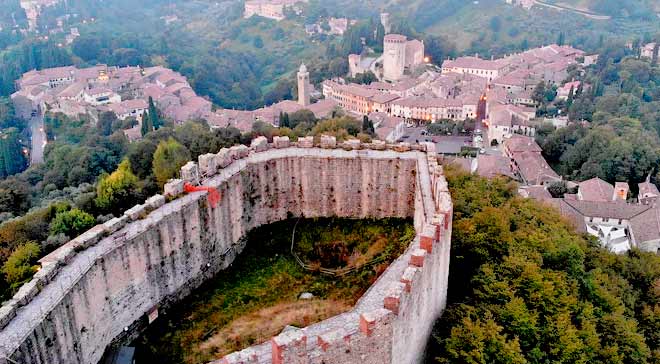
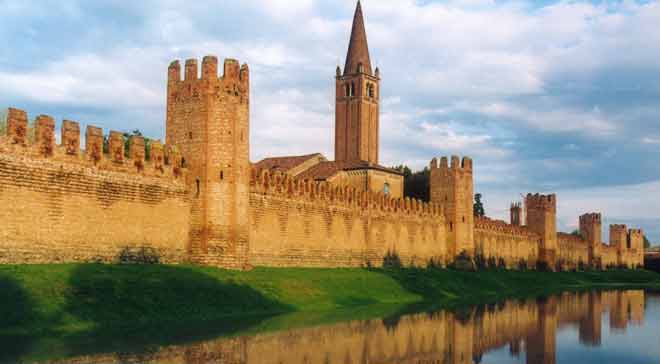
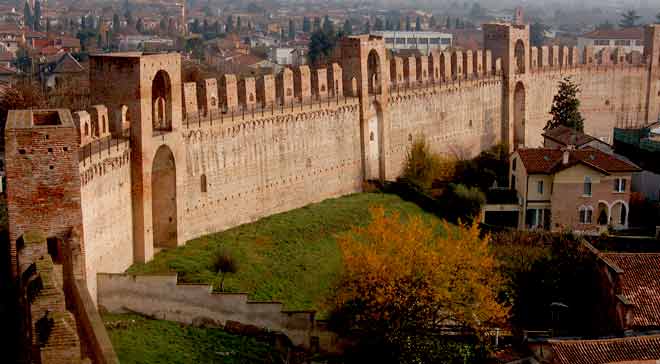
The favourable position at the centre of the intersection between important road arteries and waterways encouraged a fairly early settlement. The birth of Monselice as an urban nucleus dates back to the 5th-6th century and is due to a first fortification of the hill of the Rocca by the Byzantines, a fortification that proved important in terms of defensive strategy. The existing structures were further strengthened after the invasion of the Franks, and around the year one thousand consisted of a discontinuous inhabited fabric on the slopes of the Rocca and of a defensive nucleus guarding the bridge over the ancient river Vigenzone, which passed at the foot of the hill.
The city is mentioned by Paul the Deacon in his Historia Langobardorum as one of the few cities of the Venetia (together with Padua and Mantua) not to be occupied by Alboin between the summer and autumn of 569. A Byzantine garrison was certainly stationed in the city. (...)
The insignia of the Municipality consist of the heraldic coat of arms and the gonfalon.
The coat of arms, recognised by the Decree of the President of the Council of Ministers of 7 June 1960, is depicted thus: "azure, a mount vert encircled by three rings of walls gules, embattled in the Ghibelline manner, each opened sable with a portal argent and provided with two towers placed towards the flanks of the shield, embattled with three, the highest ring also provided with a central tower, with exterior ornaments befitting a City". The gonfalon, recognised by the Decree of the President of the Council of Ministers of 11 September 1960, consists of: "a cloth divided into red and white, richly adorned with gold embroidery and charged with the civic coat of arms with the inscription centred in gold: Città di Monselice. The metal parts and the cords shall be gilded. The vertical staff shall be covered with velvet in the colours of the cloth, alternating, with gilded studs placed in a spiral. On the spearhead shall be depicted the coat of arms of the city and on the shaft shall be engraved its name. Cravat and ribbons in the three national colours, fringed with gold".