

Torre dell'Orologio
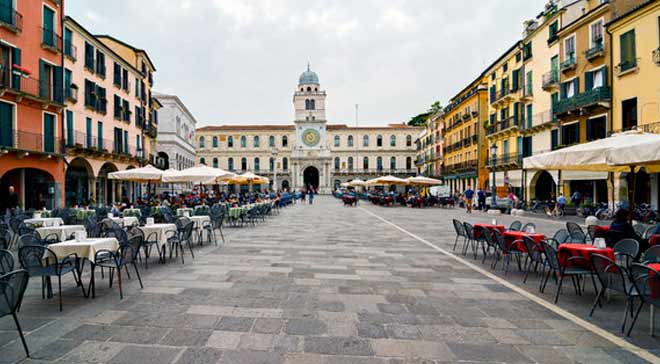
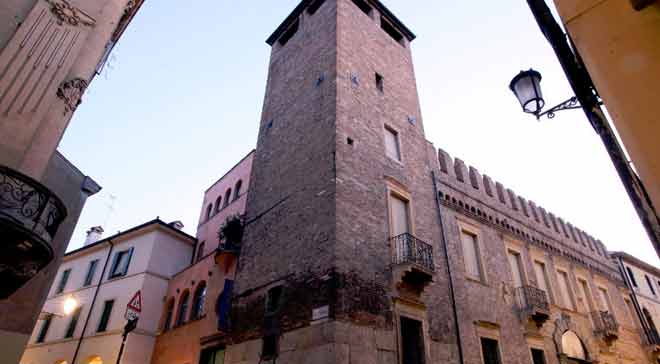
The Torre dell'Orologio is a building of medieval origin overlooking Piazza dei Signori in Padua.
It stands between the Palazzo del Capitanio and the Palazzo dei Camerlenghi.
The tower was built in the first half of the 14th century as the eastern gate of the Reggia Carrarese.
In 1428 it was raised and adorned in Gothic style and fitted with the celebrated astronomical clock.
In 1531 the great triumphal arch was added at its base, designed by Giovanni Maria Falconetto.

The structure dates back to the first half of the 14th century, when it served as the fortified eastern entrance of the Reggia Carrarese, but its present appearance is owed to the works promoted from 1426 by the Captain Bartolomeo Morosini, completed with the inauguration of the clock on the feast of Saint Anthony in 1437.
A remarkable work by Giovanni Maria Falconetto, the triumphal arch was set against the tower in order to monumentalise the square - at the time used for solemn civic ceremonies and tournaments - and the access to the Captain's Court. Built in 1531, the arch was conceived following the latest Roman architectural developments of the early sixteenth century, in the vein of Bramante, Baldassarre Peruzzi and Giulio Romano, proposing an entirely new construction for the Veneto of the time, free from the architectural decorativism of Lombard origin and foreshadowing the classicism of Andrea Palladio. The clear quotation of the ancient Roman triumphal arches (in particular the Arch of the Sergii in Pula) according to the Doric order, the base and the entablature with the hieratic inscription commemorating the Venetian Senate and Doge Andrea Gritti, dialogue with the plasticism of the two winged victories, with the mascaron on the keystone of the arch and the Marcian lion (rebuilt after the war damage of the Napoleonic era). On the entablature rest two statues depicting two figures armed in the antique manner holding the arms of Andrea Gritti. On the side of the arch a few inscriptions commemorate Vitale Lando and Giovanni Maria Falconetto himself (IO.annes MA.ria FALCONETVS VERONENSIS ARCHITETVS F.ecit).
The astronomical clock that dominates the square is the oldest machine of its kind preserved in the world; it is the reconstruction of the original mechanism placed on the tower of the southern gate of the Reggia Carrarese, built to the extraordinary design of Jacopo Dondi in 1344 and damaged by a fire that broke out during the skirmishes waged by Prince Francesco Novello against the Visconti occupation. Of this ancient fourteenth-century instrument the signs of the Zodiac survive in their original form, reused by Matteo Novello and by Giovanni and Gian Pietro delle Caldiere for the construction of the present one, completed in 1436. The framing, characterised by Ionic pilasters, is owed to Giovanni Maria Falconetto who restored the front of the tower commissioned by Vitale Lando in 1537.
The precious mechanism - which over the centuries underwent restorations and additions - is housed on the third floor of the tower, supported by a timber framework and protected by an imposing cabinet.
Among the signs of the Zodiac placed on the monumental dial facing the square, the sign of Libra is missing. This absence stems from the fact that the signs depicted refer to the pre-Roman zodiacal system in which the constellations of Scorpio and Libra were joined into one (which therefore occupied a greater space in the zodiacal band). Even today, in fact, the two parts of the constellation of Libra are called "northern claw" and "southern claw". At the time of its construction the clock also contained the representation of Libra, which was removed during a modification carried out by the abbot Bartolomeo Toffoli between 1787 and 1792, who chose to follow the more ancient zodiacal divisions. The popular tradition according to which the absence of Libra would be a spiteful gesture by the builder against the lack of justice of his patrons, who wanted to pay him less than agreed, is essentially without historical foundation.
The popularity of the astronomical clock, one of the first made in Italy, was such that the descendants of Jacopo Dondi had the name "dell'Orologio" added to their surname. Some descendants of the family still live in Padua today.
The clock returned to working order in June 2010 after careful restoration work that involved both the architectural structure of the tower and the mechanisms of the clock itself. The tower with the clock mechanism is opened to the public for guided tours every Friday and Saturday of each month from 9:30 until 11:45. (opening managed by the Salvalarte Padova - Legambiente volunteers)
On the octagonal-plan lantern a bell is installed, perhaps recast around the middle of the 18th century by Jacopo Cabani: every hour, ("toll") and about five minutes after the "toll", the "re-toll", it is struck by a hammer entirely controlled by the fifteenth-century mechanism.