

Palazzo della Ragione
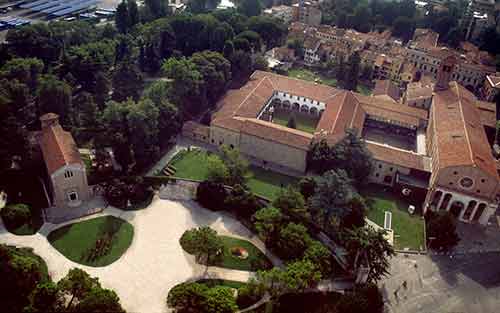
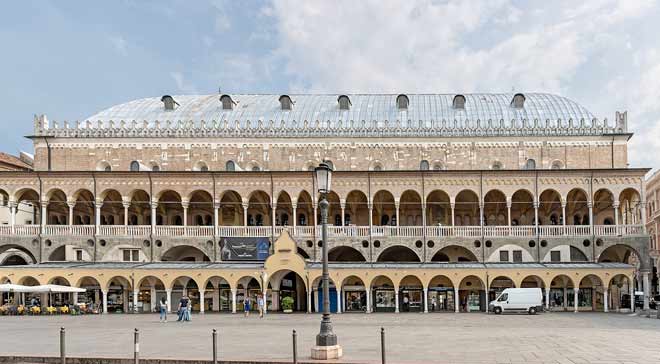
The Palazzo della Ragione (also known as the Salone, by synecdoche) was the ancient seat of the city courts of Padua.
It was erected from 1218 onwards and raised in 1306 by Giovanni degli Eremitani, who gave it its distinctive roof shaped like an upturned ship's hull.
The upper floor is occupied by the largest hanging hall in the world, known as the "Salone" (measuring 81 metres by 27 and standing 27 metres high), with a wooden ship's-keel ceiling.
It is part of the Palazzo Comunale of Padua.
The original frescoes, attributed to Giotto, were destroyed in the fire of 1420.
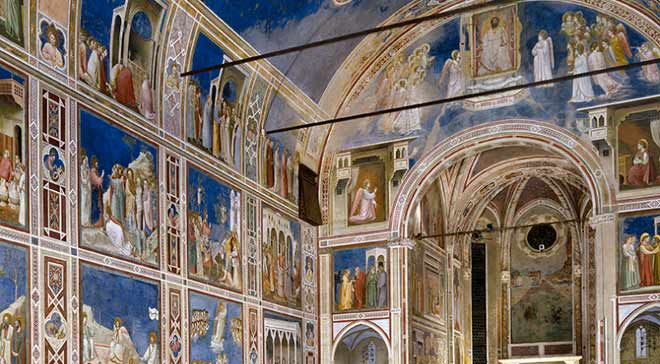
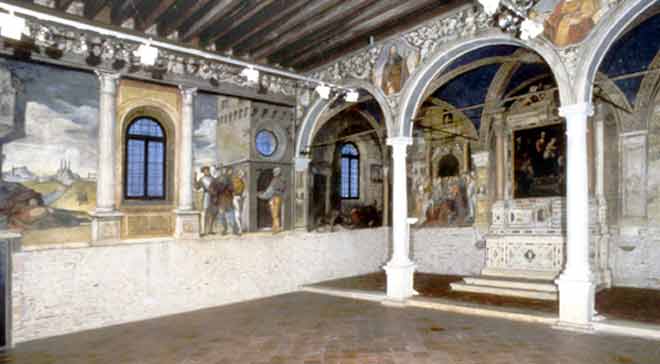
The Salone is decorated with a magnificent cycle of frescoes on an astrological theme (completed between 1425 and 1440), based on the studies of Pietro d'Abano, a follower of Averroes. The painted decoration, the work of Niccolò Miretto and Stefano da Ferrara, unfolds across the "three upper bands" of the four walls over more than 200 linear metres (the starting point is the south-east corner, the wall overlooking Piazza delle Erbe, the sign of Aries).
The astrological theme is divided into twelve compartments corresponding to the months, each arranged in three bands of nine tiers.
Each compartment includes depictions of an apostle, the allegory of the month, the zodiac sign, the planet, the typical occupations, the trades and the constellations: all around are represented the activities and individual characters of people, determined by astral influences, which in turn are linked to the date of birth and the ascendant.
In the "lower band" are depicted the insignia of the judges (discs), symbolised by animals, to which are added the cardinal virtues and the theological virtues, the patron Saints of Padua (such as Saint Justina and Anthony of Padua) and the Doctors of the Church.
Since 2000, the Palazzo's frescoes have been at the centre of a restoration project, also made possible thanks to funds from the Lotto lottery, in accordance with Law 662/96.
The hall holds a gigantic wooden horse, a Renaissance copy of the one from the Gattamelata monument by Donatello, and two Egyptian sphinxes brought here in the 19th century by Giovan Battista Belzoni. Recently, a corner of the Salone has been set aside to house a Foucault pendulum, underlining the inseparable connection between Padua and science.
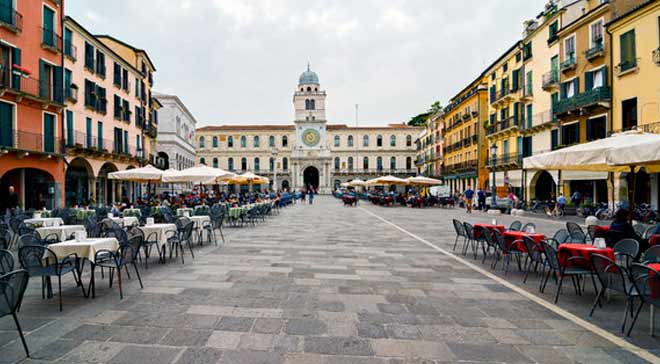
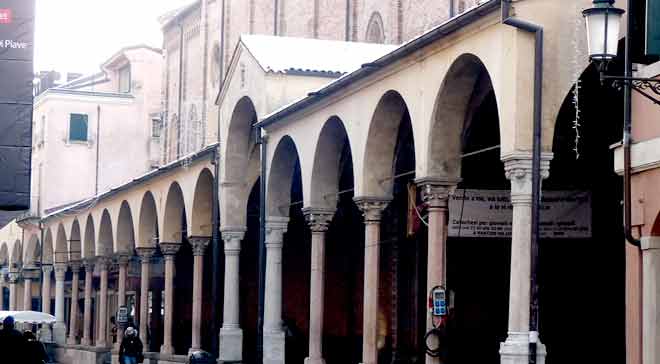
The Salone divides the two great squares of Piazza delle Erbe and Piazza della Frutta, home to Padua's markets. Beneath the Salone, along two parallel galleries, lie numerous characteristic food shops.
As an ideal link to its original function, it is physically connected on its eastern side to the present-day town hall.
As for the history of the building, it is reasonable to suppose that the site on which the present Palazzo stands was built upon and inhabited in earlier times. Beneath the Palazzo there indeed remains a memory of the Roman era, and the small Romanesque carved heads placed on the jambs of the arches giving access to the market beneath the Salone are proof of this. The exact date of the original construction is unknown, but as early as 1166 the lower part of the building, which served public functions, already existed.
The first construction dates back to 1219 and was intended to house the courts and financial offices, a role it held not only in the communal era but, albeit with reduced use, also during the Carraresi seigniory and throughout Venetian rule, until 1797. It was also, however, a commercial venue, the one function it retained over time. There is therefore a close link between the Salone and justice.
The intensification of trade in the area of the squares prompted the Comune to undertake a regulatory measure that would also materially affirm public protection over commercial activities. The first statutes regulating life in the communal cities date back to the beginning of the 12th century and concern above all trade and political institutions. Its present form is owed to friar Giovanni degli Eremitani, who between 1306 and 1309 had the great wooden vault with two domes raised and added the portico and loggias, covering the stairs. The roof was rebuilt with larch-wood trusses, without central columns, and covered with lead plates.
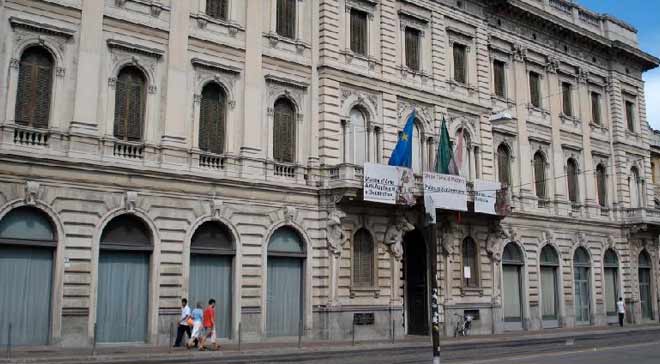
The great hall was reached by four staircases that took their names from the market held at their foot: the Birds' Stairway (Scala degli osei) at the Volto della Corda, that of wrought iron in Piazza delle Erbe, the Wine Stairway, again in Piazza delle Erbe, and that of the fruit in the square of the same name. In the communal era there was a suspended passageway leading from the small loggia to the opposite Palazzo delle Debite, seat of the praetorial prisons intended to hold insolvent debtors. The ancient building was demolished in 1873 and replaced by the present palazzo, which bears the same name, designed by Camillo Boito. Still in existence, however, is the eastern connection to the town hall, known as the Volto della Corda.
On 17 August 1756 a furious whirlwind devastated the great building, destroying its roof and tearing it off. Bartolomeo Ferracina, clockmaker and engineer of the Serenissima, better known for building the clock in Piazza San Marco in Venice and also responsible for the reconstruction of the Palladian bridge at Bassano del Grappa, oversaw the rebuilding of the imposing structure. With the courts transferred in 1797, the Salone was opened for great public gatherings, anniversaries and celebrations.