

The Old Ghetto
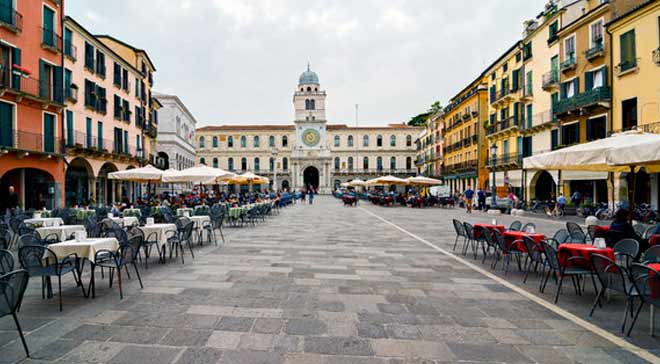
To the south of Piazza delle Erbe winds a labyrinth of narrow streets that form the Jewish Ghetto, in operation from 1603 and abolished in 1797, the year in which, driven by the French Revolution, the Jews were declared free and equal.
The first Jewish settlements in Padua date back to the 12th century, but it was after the mid-1300s that the community grew and developed, thanks in part to the founding of the University which, unlike all the others in Italy and Europe, always accepted students of every religion, including the Jewish one. Then, in the communal and Carrarese era, the growth of trade drew many moneylenders and sellers of second-hand goods to the city, thus making Padua a meeting point for Jews of different origins and cultures. The original settlements of S. Leonardo (along the Tronco Maestro of the Bacchiglione, near Via Savonarola) soon became insufficient and impractical, given their distance both from the trading area of Piazza delle Erbe and from the University. Three groupings were thus created: the Italians in the area of Porta Altinate, the Germans (Ashkenazi) and the Spanish (Sephardi) in the area behind S. Canziano.

After the War of the League of Cambrai against the Venetian Republic and the consequent sieges of Padua that lasted from 1509 to 1513, the Italian community too moved to the area close to Piazza delle Erbe, in what would later become the Ghetto of Padua.
The ghetto, "Loco stabile et separato, deputato agli Ebrei; né alcun cristiano in quello possi star, overo tegnir botéga" (a fixed and separate place, assigned to the Jews; nor may any Christian dwell or keep a shop therein), as a notice of 1603 stated, was closed at night by four gates, each guarded by a Jew and a Christian, paid by the Jewish Community: the northern one in Via delle Piazze, just south of San Canziano; the eastern one, the gate of Santa Giuliana, built at the behest of the podestà and the grand council, in Via San Martino e Solferino, once Via Sirena, near where it meets Via Roma; the western one on the same street, before the junction with Via dei Fabbri; the southern one in Via dell'Arco, where it joins Via Marsala. These gates prevented the Jews from going out after two in the morning; in 1797 they were demolished and the Jews were called to become part of the municipality. Traces of the hinges remain on the western side of the Church of S. Canziano and on a wall of a building at the corner of Via S. Martino e Solferino with Via Roma, where two plaques, one in Latin and the other in Hebrew, reminded the Jews to withdraw within their quarter at sunset.
In the 1600s almost all the Jews of Italy were by then confined to the ghettos. The Italian ghettos consisted either of a large rectangular courtyard, along which the houses were lined up, with the shops and the intercommunicating dwellings, the typical chatzèr, that is the courtyard; or of a central street or square into which secondary side alleys opened, or of a complex of little streets forming a small quarter in the centre (as in the case of Padua); or even, the smallest ones, of a single lane with two gates at its openings.
No Jew could live outside the ghetto, nor leave it without the "Jewish badge" (a yellow or white-and-red roundel, or a yellow hat, or yellow ribbons or a yellow veil). Only the Venetian Republic allowed Jews passing through to move about for three days without it.
In the 1600s there were as many as 63 very busy shops in the Ghetto where everything was sold. The Jews, however, practised above all the trade of "strazzeria", the small-scale dealing in used goods, with their much-frequented shops. Many devoted themselves to the silversmith's industry, which they started and brought to great development, until 1777 when the Venetian Republic permitted them to practise only the trade of "strazzaria". Since they were not admitted to the guilds of Arts and Crafts, they practised moneylending, an activity forbidden to Christians, which secured for many lenders the right of residence thanks to the intercession of the feudal lords, who always had the need to quickly procure money to maintain their militias. Students and professors resorted to their "banks" for loans and pledges. The first official bank run by a Jew dates back to 1372 near Ponte Molino; another began its activity in 1369 in Piazza delle Legne (today's Piazza Cavour), where it seems a synagogue also stood. Little by little their activities began to gravitate around the area where the ghetto would later arise.
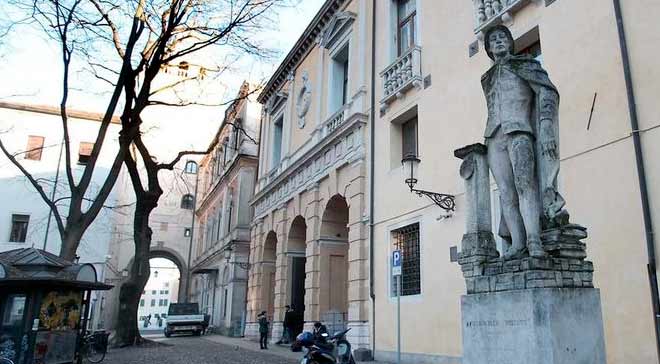
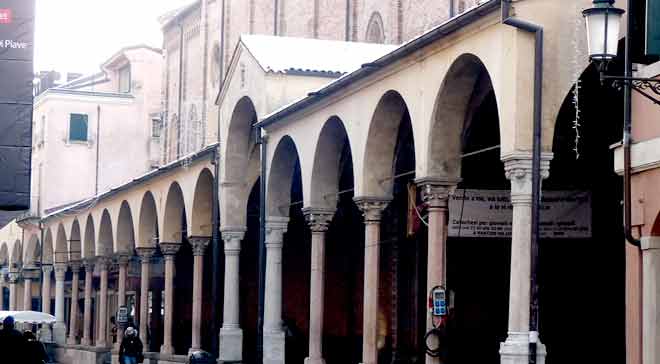
Since Jews were forbidden to reside elsewhere, as in Venice, the houses of the quarter, heterogeneous and often rich in salvaged elements, developed upwards and, despite the transformations and rebuildings, still preserve their Romanesque layout. Of particular interest are the four columns with all-different capitals in Via San Martino e Solferino, opposite the entrance of Via dell'Arco. In Via dell'Arco stands the Hotel Toscanelli, once the seat of the Rabbinical Academy, of which it still preserves a fireplace bearing the coat of arms of the Salom family.
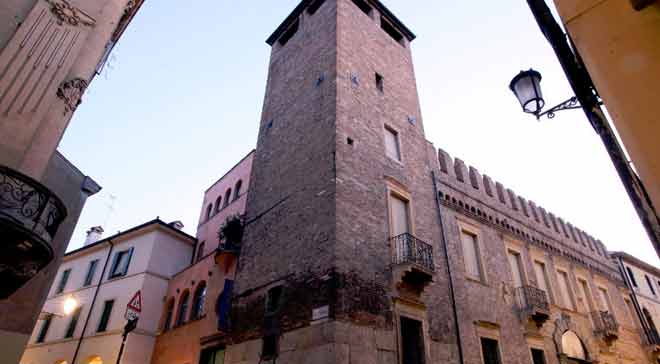
At the corner with Via Spirito Santo and Via Marsala one can still observe the raised tower-houses, typical of the Jewish quarter. Palazzo Strozzi, at no. 37 of Via S. Martino Solferino, was the seat of the economic activities of the Florentine exile Palla Strozzi, who arrived in Padua in 1434. It is said that the old merchant kept watch over his apprentices, who ran a bank in Piazza delle Erbe, from the little balcony beneath the portico. A little further on, through a passageway, one reaches the Corte Lenguazza, with a small loggia and ruins of the old Synagogue. In the past it formed the lively social and religious centre of the quarter: here one could buy unleavened bread and meat prepared according to the strict Jewish precepts. To the east, in Via delle Piazze, stood the first great Synagogue of German rite, which was inaugurated in 1525 and which in 1943 was destroyed by a fire. Its restoration was completed in 1998.
By appointment it is possible to visit some of the seven Jewish cemeteries still in existence: the ancient ones in the Borgese area, with tombs of celebrated figures of European Judaism; the modern one of Brusegana, whose tombs are direct testimony to the important role played in the city by the Jews in the nineteenth century. Another important testimony to Paduan Judaism is the Palazzo Cumano in Via San Gregorio Barbarico, which in the 19th century housed the Rabbinical College of Lombardy-Venetia, to which students of the rabbinate from all over the Habsburg empire flocked.
During the 1800s the ghetto fully entered the life of the city and especially that of the students. Arnaldo Fusinato recalls the origin of the saying "restare in bolletta" (to be broke): students without money sold their cloak in the ghetto in exchange for which they received a stamped paper (bolletta).
After the application of the racial laws of 1938 the Jewish community of Padua numbered about 300 members and after the liberation there were about 200. The deportees who never returned were 46.
The beauty of the ghetto lies in its narrow streets, in the evocative façades of some small palaces, in the very tall dwellings, in the little shops of ancient tradition, which spread to the surrounding streets as well after the suppression of the Ghetto.
Today, many wine bars and typical little venues are concentrated in this evocative area.
Just beyond the boundary of the historic ghetto, in Via Marsala, stands Palazzo Papafava dei Carraresi (see the website www.turismopadova.it), belonging to one of the oldest and most important families in the city.
Where it is: the area still popularly called "Ghetto" extends between Via Marsala to the south, Via Roma to the east, Piazza del Duomo-Via Barbarigo to the west and Via Manin-Piazza delle Erbe-Via San Canziano to the north. Its main axis is Via San Martino e Solferino.