

Piazza Capitaniato
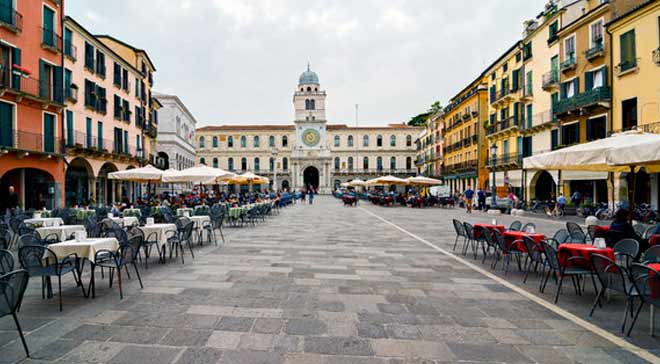
Corte Capitaniato, today Piazza Capitaniato, is a historic square in the city of Padua.
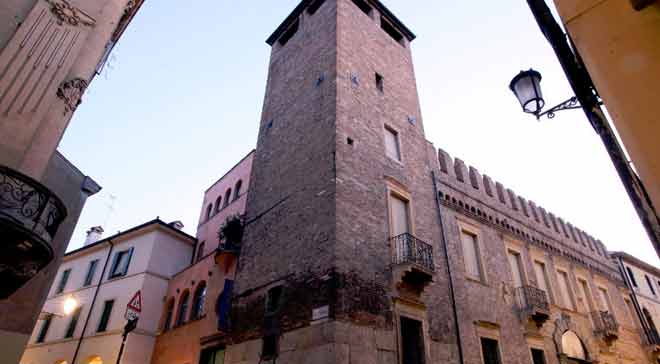
It is reached from Piazza dei Signori by passing beneath the Torre dell'Orologio, through the Porta del Capitaniato, a passage known as Soto ea scavesà (literally: under the broken one), which fell into disuse towards the end of the 20th century.
The space was originally a courtyard of the Carraresi palace, commissioned by Ubertino da Carrara in the 14th century. It was surrounded by buildings put to various uses, above all the great building housing the Sala dei Giganti. The court grew in importance during the period of Venetian rule, when the Capitanio and members of the Paduan administration were installed in the buildings of the Carraresi. The ancient courtyard, which took the name of Corte Capitaniato, came to house the seat of the curia, the administrative offices, the stables, the training grounds and the guards' quarters.
The Venetian captains were responsible for military affairs and worked alongside the podestà, to whom the management of civil administration was entrusted.
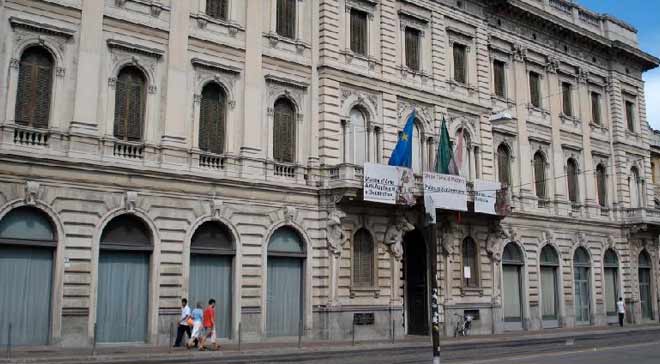
On the eastern side stands the rear of the Torre dell'Orologio and the Palazzo del Capitanio, today the seat of municipal offices and of the Department of Philosophy, Sociology, Education and Applied Psychology (FISPPA) of the University of Padua.
On the southern side stands the seat of the School of Human, Social and Cultural Heritage Sciences (formerly the Faculty of Letters and Philosophy) and of the Department of Cultural Heritage: Archaeology, History of Art, of Cinema and of Music. The latter is located in the Palazzo Liviano, built in the 1930s by the architect Gio Ponti in the spaces previously occupied by the palace of the Carraresi.
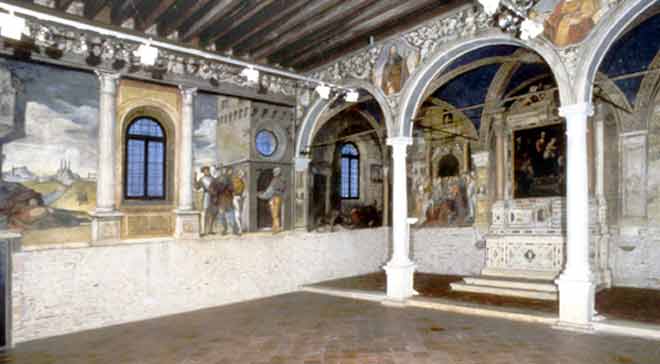
On the eastern side of the Liviano is the staircase that leads both to the elegant Sala dei Giganti, an ancient structure now used as a concert hall, whose fine frescoes were probably created by Altichiero and Jacopo Avanzi, and to the smaller Sala delle Edicole, likewise frescoed. From the square one can admire other parts of what remains of the various reconstructions of the palace, near which is also the original Loggia dei Carraresi.
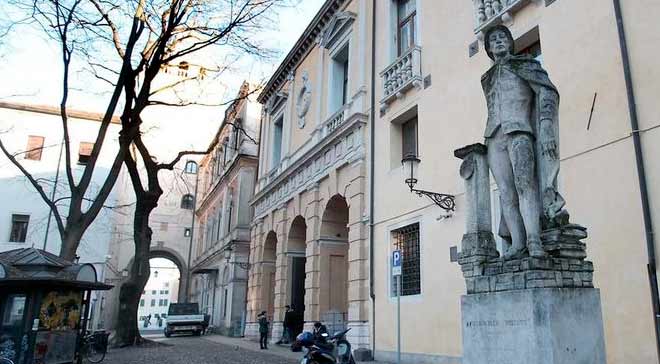
The presence of the two university departments brings a large number of students to the square, especially for graduation celebrations, when "papyri" are hung on the trees and pranks and songs take place. In Piazza Capitaniato stood, until December 2015, the large statue by Amleto Sartori depicting the playwright Angelo Beolco, known as il Ruzante, commissioned by the Rotary Club of Padua in 1958 and relocated to the Teatro Verdi.
Along the central axis of the square stand some of the oldest trees in Padua, such as the "Japanese pagoda trees" (or Styphnolobium japonicum) planted in 1861, as well as the hackberries (or Celtis australis).